Spanish Grammar Exercises: Mastering Key Concepts
Spanish grammar can seem daunting at first, but with consistent practice and focused exercises, it becomes much more manageable. A solid understanding of Spanish grammar is crucial for effective communication, whether you’re writing emails, engaging in conversations, or reading literature.
This comprehensive guide provides a wealth of exercises, explanations, and examples to help you solidify your grasp of essential Spanish grammar concepts. Whether you’re a beginner or an advanced learner, this article will provide valuable tools and strategies to improve your Spanish proficiency.
Table of Contents
- Introduction
- What is Spanish Grammar?
- Structural Breakdown of Spanish Grammar
- Nouns and Articles
- Verbs
- Adjectives
- Pronouns
- Prepositions
- Sentence Structure
- Examples
- Usage Rules
- Common Mistakes
- Practice Exercises
- Advanced Topics
- FAQ
- Conclusion
What is Spanish Grammar?
Spanish grammar, like any language’s grammar, is the set of structural rules that govern the composition of clauses, phrases, and words. It dictates how words are combined to form meaningful sentences.
Understanding Spanish grammar is essential for both comprehending and producing accurate and fluent Spanish.
Spanish grammar encompasses various aspects, including morphology (the study of word formation), syntax (the arrangement of words in sentences), and phonology (the sound system). Mastery of these elements enables effective communication and avoids misunderstandings.
The grammatical rules provide a framework for constructing sentences that are not only grammatically correct but also convey the intended meaning clearly.
Structural Breakdown of Spanish Grammar
The structure of Spanish grammar can be broken down into several core components, each playing a crucial role in forming coherent and meaningful sentences. These components include nouns, articles, verbs, adjectives, pronouns, adverbs, prepositions, conjunctions, and interjections.
Each part of speech has its own set of rules and functions, and understanding how they interact is key to mastering Spanish grammar.
Spanish sentence structure generally follows a Subject-Verb-Object (SVO) order, though variations are common, especially with pronouns. Verb conjugation is a central aspect of Spanish grammar, as verbs change form to indicate tense, mood, person, and number.
Adjectives must agree in gender and number with the nouns they modify, adding another layer of complexity. Prepositions play a vital role in connecting words and phrases, indicating relationships such as location, time, and direction.
Nouns and Articles
Gender and Number
In Spanish, nouns have grammatical gender: masculine or feminine. This gender affects the articles and adjectives that accompany the noun.
Nouns also have number: singular or plural. The gender and number of a noun must agree with the articles and adjectives that modify it.
Generally, nouns ending in “-o” are masculine (e.g., el libro – the book), and nouns ending in “-a” are feminine (e.g., la casa – the house). However, there are exceptions (e.g., el día – the day). To form the plural, add “-s” to nouns ending in a vowel (e.g., libros, casas) and “-es” to nouns ending in a consonant (e.g., el árbol – the tree, los árboles – the trees).
Definite and Indefinite Articles
Spanish has both definite and indefinite articles. Definite articles (el, la, los, las) correspond to “the” in English and are used to refer to specific nouns. Indefinite articles (un, una, unos, unas) correspond to “a,” “an,” or “some” in English and are used to refer to non-specific nouns.
The choice of article depends on the gender and number of the noun. For example, el is used for singular masculine nouns, la for singular feminine nouns, los for plural masculine nouns, and las for plural feminine nouns. Similarly, un is used for singular masculine nouns, una for singular feminine nouns, unos for plural masculine nouns, and unas for plural feminine nouns.
Verbs
Verb Conjugation
Verb conjugation is a fundamental aspect of Spanish grammar. Spanish verbs change form to indicate tense (present, past, future, etc.), mood (indicative, subjunctive, imperative), person (yo, tú, él/ella/usted, nosotros, vosotros, ellos/ellas/ustedes), and number (singular, plural).
Mastering verb conjugation is essential for constructing grammatically correct sentences.
Spanish verbs are typically grouped into three conjugations based on their infinitive ending: -ar, -er, and -ir. Each conjugation has its own set of endings for each tense and person. For example, the present tense conjugation of the verb hablar (to speak) is: yo hablo, tú hablas, él/ella/usted habla, nosotros hablamos, vosotros habláis, ellos/ellas/ustedes hablan.
Regular and Irregular Verbs
Spanish verbs can be classified as either regular or irregular. Regular verbs follow predictable conjugation patterns, while irregular verbs have exceptions to these patterns.
Irregular verbs often have stem changes (changes in the root of the verb) or irregular endings in certain tenses.
Common irregular verbs include ser (to be), estar (to be), tener (to have), ir (to go), and hacer (to do/make). These verbs have unique conjugations that must be memorized. Recognizing and learning irregular verbs is crucial for accurate and fluent Spanish communication.
Ser vs. Estar
The verbs ser and estar both translate to “to be” in English, but they are used in different contexts. Ser is used to describe permanent or inherent characteristics, such as identity, origin, nationality, physical traits, and time. Estar is used to describe temporary states, conditions, emotions, locations, and progressive actions.
For example, “Yo soy alto” (I am tall) uses ser because height is a permanent characteristic. “Yo estoy cansado” (I am tired) uses estar because tiredness is a temporary state. Understanding the distinction between ser and estar is essential for accurate Spanish usage.
Adjectives
Agreement
In Spanish, adjectives must agree in gender and number with the nouns they modify. This means that if a noun is masculine and singular, the adjective must also be masculine and singular.
If a noun is feminine and plural, the adjective must also be feminine and plural.
For example, “el libro rojo” (the red book) uses the masculine singular adjective rojo because libro is a masculine singular noun. “Las casas rojas” (the red houses) uses the feminine plural adjective rojas because casas is a feminine plural noun.
Position
In Spanish, adjectives typically follow the nouns they modify. However, there are exceptions.
Descriptive adjectives often come after the noun, while adjectives that express inherent qualities or opinions may come before the noun.
For example, “la casa grande” (the big house) places the adjective grande after the noun casa. However, “una buena persona” (a good person) places the adjective buena before the noun persona.
Pronouns
Subject Pronouns
Subject pronouns replace nouns as the subject of a sentence. The Spanish subject pronouns are: yo (I), tú (you, informal), él (he), ella (she), usted (you, formal), nosotros (we, masculine or mixed), nosotras (we, feminine), vosotros (you, plural informal, masculine or mixed), vosotras (you, plural informal, feminine), ellos (they, masculine or mixed), ellas (they, feminine), and ustedes (you, plural formal).
For example, “Yo hablo español” (I speak Spanish) uses the subject pronoun yo. “Ellos estudian mucho” (They study a lot) uses the subject pronoun ellos.
Object Pronouns
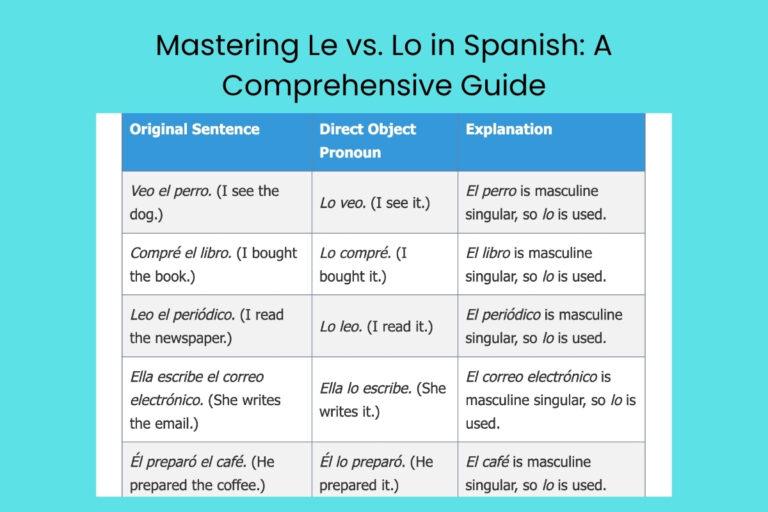
Object pronouns replace nouns as the direct or indirect object of a verb. Direct object pronouns receive the action of the verb, while indirect object pronouns indicate to whom or for whom the action is done. The direct object pronouns are: me (me), te (you, informal), lo (him, it, masculine), la (her, it, feminine), nos (us), os (you, plural informal), los (them, masculine), and las (them, feminine). The indirect object pronouns are: me (to/for me), te (to/for you, informal), le (to/for him/her/you, formal), nos (to/for us), os (to/for you, plural informal), and les (to/for them/you, formal).
For example, “Me gusta el café” (I like coffee) uses the indirect object pronoun me. “Lo veo” (I see him) uses the direct object pronoun lo.
Reflexive Pronouns
Reflexive pronouns are used when the subject and object of a verb are the same. The reflexive pronouns are: me (myself), te (yourself, informal), se (himself, herself, itself, yourself, formal), nos (ourselves), os (yourselves, plural informal), and se (themselves, yourselves, formal).
For example, “Me lavo las manos” (I wash my hands) uses the reflexive pronoun me. “Se visten” (They get dressed) uses the reflexive pronoun se.
Prepositions
Prepositions are words that connect nouns, pronouns, or phrases to other words in a sentence. They indicate relationships such as location, time, direction, and manner. Common Spanish prepositions include: a (to, at), en (in, on, at), de (of, from), para (for, to), por (by, for), con (with), sin (without), sobre (on, about), entre (between, among), and desde (from, since).
For example, “Voy a la escuela” (I go to school) uses the preposition a. “El libro está sobre la mesa” (The book is on the table) uses the preposition sobre.
Sentence Structure
The basic Spanish sentence structure typically follows a Subject-Verb-Object (SVO) order, similar to English. However, Spanish allows for more flexibility in word order, especially with pronouns.
It’s also common to omit the subject pronoun when the verb conjugation clearly indicates the subject.
For example, “Yo como manzanas” (I eat apples) follows the SVO order. However, “Manzanas como” (Apples I eat) is also grammatically correct, though less common. “Como manzanas” (I eat apples) omits the subject pronoun yo.
Examples
Nouns and Articles Examples
This table provides examples of nouns and their corresponding articles, demonstrating gender and number agreement.
| Noun (Singular) | Article (Singular) | Noun (Plural) | Article (Plural) | Translation |
|---|---|---|---|---|
| Libro | El | Libros | Los | Book(s) |
| Casa | La | Casas | Las | House(s) |
| Coche | El | Coches | Los | Car(s) |
| Mesa | La | Mesas | Las | Table(s) |
| Perro | El | Perros | Los | Dog(s) |
| Gata | La | Gatas | Las | Cat(s) (female) |
| Día | El | Días | Los | Day(s) |
| Mano | La | Manos | Las | Hand(s) |
| Profesor | El | Profesores | Los | Professor(s) |
| Profesora | La | Profesoras | Las | Professor(s) (female) |
| Estudiante | El/La | Estudiantes | Los/Las | Student(s) |
| Problema | El | Problemas | Los | Problem(s) |
| Canción | La | Canciones | Las | Song(s) |
| Árbol | El | Árboles | Los | Tree(s) |
| Ciudad | La | Ciudades | Las | City/Cities |
| País | El | Países | Los | Country/Countries |
| Lección | La | Lecciones | Las | Lesson(s) |
| Idioma | El | Idiomas | Los | Language(s) |
| Universidad | La | Universidades | Las | University/Universities |
| Teléfono | El | Teléfonos | Los | Telephone/Telephones |
| Flor | La | Flores | Las | Flower(s) |
| Cielo | El | Cielos | Los | Sky/Skies |
| Mar | El | Mares | Los | Sea/Seas |
| Noche | La | Noches | Las | Night(s) |
| Sol | El | Soles | Los | Sun(s) |
Verb Examples
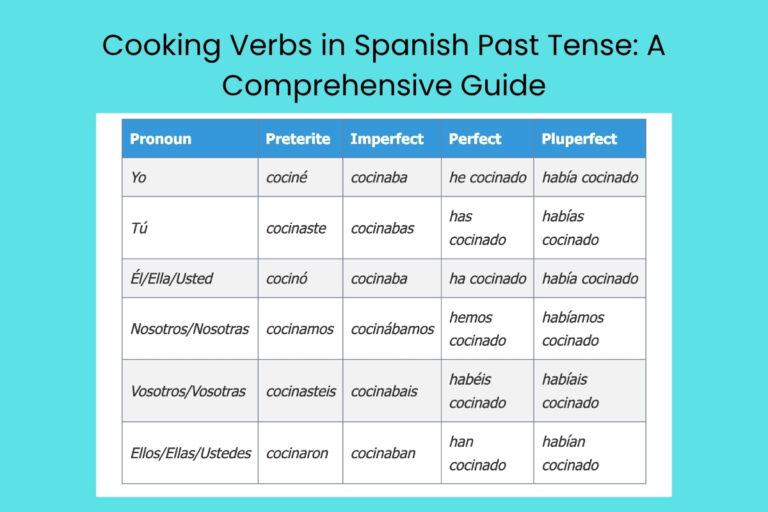
This table provides examples of verb conjugations in different tenses.
| Pronoun | Present (Hablar – To Speak) | Past (Comer – To Eat) | Future (Vivir – To Live) | Conditional (Poder – To Be Able To) |
|---|---|---|---|---|
| Yo | Hablo | Comí | Viviré | Podría |
| Tú | Hablas | Comiste | Vivirás | Podrías |
| Él/Ella/Usted | Habla | Comió | Vivirá | Podría |
| Nosotros | Hablamos | Comimos | Viviremos | Podríamos |
| Vosotros | Habláis | Comisteis | Viviréis | Podríais |
| Ellos/Ellas/Ustedes | Hablan | Comieron | Vivirán | Podrían |
This table provides examples of irregular verb conjugations in the present tense.
| Pronoun | Ser (To Be) | Estar (To Be) | Tener (To Have) | Ir (To Go) | Hacer (To Do/Make) |
|---|---|---|---|---|---|
| Yo | Soy | Estoy | Tengo | Voy | Hago |
| Tú | Eres | Estás | Tienes | Vas | Haces |
| Él/Ella/Usted | Es | Está | Tiene | Va | Hace |
| Nosotros | Somos | Estamos | Tenemos | Vamos | Hacemos |
| Vosotros | Sois | Estáis | Tenéis | Vais | Hacéis |
| Ellos/Ellas/Ustedes | Son | Están | Tienen | Van | Hacen |
Adjective Examples
This table provides examples of adjective agreement with nouns.
| Noun (Singular) | Adjective (Singular) | Noun (Plural) | Adjective (Plural) | Translation |
|---|---|---|---|---|
| Libro | Rojo | Libros | Rojos | Red book(s) |
| Casa | Grande | Casas | Grandes | Big house(s) |
| Coche | Nuevo | Coches | Nuevos | New car(s) |
| Mesa | Pequeña | Mesas | Pequeñas | Small table(s) |
| Perro | Feliz | Perros | Felices | Happy dog(s) |
| Gata | Blanca | Gatas | Blancas | White cat(s) |
Pronoun Examples
This table provides examples of subject, direct object, and indirect object pronouns in sentences.
| Pronoun Type | Pronoun | Example Sentence | Translation |
|---|---|---|---|
| Subject | Yo | Yo hablo español. | I speak Spanish. |
| Subject | Tú | Tú estudias mucho. | You study a lot. |
| Direct Object | Lo | Lo veo. | I see him. |
| Direct Object | La | La conozco. | I know her. |
| Indirect Object | Me | Me gusta el café. | I like coffee. |
| Indirect Object | Le | Le doy un regalo. | I give him/her a gift. |
| Reflexive | Me | Me lavo las manos. | I wash my hands. |
| Reflexive | Se | Se visten. | They get dressed. |
Preposition Examples
This table provides examples of sentences using different prepositions.
| Preposition | Example Sentence | Translation |
|---|---|---|
| A | Voy a la escuela. | I go to school. |
| En | Estoy en la casa. | I am in the house. |
| De | Soy de España. | I am from Spain. |
| Para | Este regalo es para ti. | This gift is for you. |
| Por | Viajo por Europa. | I travel through Europe. |
| Con | Voy con mi amigo. | I go with my friend. |
| Sin | Estoy sin dinero. | I am without money. |
| Sobre | El libro está sobre la mesa. | The book is on the table. |
| Entre | Está entre nosotros. | It’s between us. |
| Desde | Estudio desde ayer. | I have been studying since yesterday. |
Usage Rules
Spanish grammar has specific usage rules that govern how words are combined to form sentences. Noun-adjective agreement requires that adjectives match the gender and number of the nouns they modify.
Verb conjugations must be accurate to reflect tense, mood, person, and number. Pronoun placement can vary, but generally, object pronouns precede the verb.
Prepositions must be used correctly to indicate relationships between words and phrases.
Exceptions to these rules exist, particularly with irregular verbs and certain adjective placements. For example, some adjectives change meaning depending on whether they precede or follow the noun.
Mastering these nuances requires careful study and practice. Paying attention to context and common usage patterns is also crucial for accurate and fluent Spanish communication.
Common Mistakes
Common mistakes in Spanish grammar include incorrect verb conjugations, errors in noun-adjective agreement, misuse of ser and estar, and incorrect pronoun placement. For example, using the wrong verb ending can change the meaning of a sentence or make it grammatically incorrect. Failing to match the gender and number of adjectives with the nouns they modify can lead to confusion. Using ser when estar is required, or vice versa, can convey the wrong information.
Here are some examples of common mistakes and their corrections:
| Incorrect | Correct | Explanation |
|---|---|---|
| Yo *es* estudiante. | Yo *soy* estudiante. | Ser is used for permanent characteristics. |
| El libro *rojas*. | El libro *rojo*. | Adjective must agree in gender and number with the noun. |
| *Lo* doy el libro a Juan. | *Le* doy el libro a Juan. | Le is the correct indirect object pronoun for “to him.” |
| Estoy *ser* cansado. | Estoy *estar* cansado. | Estar is used for temporary states. |
Practice Exercises
Exercise 1: Nouns and Articles
Fill in the blanks with the correct definite or indefinite article (el, la, los, las, un, una, unos, unas).
- _____ libro está sobre _____ mesa.
- Tengo _____ perro y _____ gato.
- _____ estudiantes son muy inteligentes.
- Necesito _____ bolígrafo para escribir.
- _____ casas en esta calle son muy bonitas.
- ¿Tienes _____ coche nuevo?
- _____ agua es muy importante para la vida.
- Compré _____ manzanas en _____ mercado.
- _____ día es muy soleado hoy.
- _____ flores en el jardín son hermosas.
Answers:
- El, la
- Un, un
- Los
- Un
- Las
- Un
- El
- Unas, el
- El
- Las
Exercise 2: Verb Conjugation
Conjugate the verb in parentheses in the present tense.
- Yo _____ (hablar) español.
- Tú _____ (comer) pizza.
- Él _____ (vivir) en Madrid.
- Nosotros _____ (estudiar) mucho.
- Vosotros _____ (trabajar) en una oficina.
- Ellos _____ (bailar) salsa.
- Yo _____ (ser) estudiante.
- Tú _____ (estar) cansado.
- Él _____ (tener) un coche.
- Nosotros _____ (ir) al cine.
Answers:
- Hablo
- Comes
- Vive
- Estudiamos
- Trabajáis
- Bailan
- Soy
- Estás
- Tiene
- Vamos
Exercise 3: Adjectives
Fill in the blank with the correct form of the adjective in parentheses.
- El libro es _____. (rojo)
- La casa es _____. (grande)
- Los coches son _____. (nuevo)
- Las mesas son _____. (pequeño)
- Los perros son _____. (feliz)
- La gata es _____. (blanco)
- Las flores son _____. (bonito)
- El cielo es _____. (azul)
- Los estudiantes son _____. (inteligente)
- La lección es _____. (fácil)
Answers:
- Rojo
- Grande
- Nuevos
- Pequeñas
- Felices
- Blanca
- Bonitas
- Azul
- Inteligentes
- Fácil
Exercise 4: Pronouns
Choose the correct pronoun to complete the sentence.
- _____ llamo Juan. (Yo/Me)
- _____ gusta el chocolate. (Me/Yo)
- _____ veo en el parque. (Te/Tú)
- Él _____ da un regalo a mí. (me/le)
- _____ lavamos las manos. (Nos/Nosotros)
- ¿_____ conoces a ella? (La/Le)
- _____ explico la lección a ellos. (Les/Los)
- _____ quieres mucho. (Te/Tú)
- _____ dan las gracias a nosotros. (Nos/Les)
- Ellos _____ visten cada día. (se/los)
Answers:
- Me
- Me
- Te
- Me
- Nos
- La
- Les
- Te
- Nos
- Se
Exercise 5: Prepositions
Fill in the blank with the correct preposition.
- Voy _____ la escuela. (a/en)
- Estoy _____ la casa. (a/en)
- Soy _____ España. (de/a)
- Este regalo es _____ ti. (para/por)
- Viajo _____ Europa. (para/por)
- Voy _____ mi amigo. (con/sin)
- Estoy _____ dinero. (con/sin)
- El libro está _____ la mesa. (sobre/entre)
- Está _____ nosotros. (sobre/entre)
- Estudio _____ ayer. (desde/hasta)
Answers:
- A
- En
- De
- Para
- Por
- Con
- Sin
- Sobre
- Entre
- Desde
Advanced Topics
Advanced topics in Spanish grammar include the subjunctive mood, the use of different past tenses (preterite vs. imperfect), and complex sentence structures. The subjunctive mood is used to express doubt, uncertainty, wishes, and emotions.
Mastering the subjunctive requires understanding its various uses and conjugations.
The preterite and imperfect past tenses are used to describe past actions, but they differ in their usage. The preterite is used for completed actions, while the imperfect is used for ongoing or habitual actions in the past.
Complex sentence structures involve the use of relative clauses, conditional clauses, and other grammatical constructions to express more nuanced ideas.
FAQ
Q: How can I improve my Spanish grammar skills?
A: Consistent practice is key. Work through grammar exercises, read Spanish texts, and engage in conversations with native speakers.
Pay attention to your mistakes and learn from them.
Q: What are the most important grammar concepts to learn?
A: Noun-article agreement, verb conjugation, adjective agreement, pronoun usage, and prepositions are essential for building a solid foundation in Spanish grammar.
Q: How do I know when to use ser vs. estar?
A: Ser is used for permanent or inherent characteristics, while estar is used for temporary states, conditions, emotions, and locations.
Q: Where can I find more practice exercises?
A: Many online resources, textbooks, and language learning apps offer a variety of Spanish grammar exercises. Look for materials that provide clear explanations and answer keys.
Q: How important is it to memorize verb conjugations?
A: Memorizing verb conjugations is crucial for accurate and fluent Spanish communication. Focus on the most common verbs and tenses first, and gradually expand your knowledge.
Conclusion
Mastering Spanish grammar requires dedication, practice, and a systematic approach. By understanding the core components of Spanish grammar, working through exercises, and paying attention to common mistakes, you can significantly improve your Spanish proficiency.
Consistent effort and a willingness to learn from your errors will lead to greater fluency and confidence in your Spanish communication skills.