Mastering Spanish Action Verbs: A Comprehensive Guide
Understanding Spanish action verbs is crucial for expressing actions, events, and processes in the Spanish language. Action verbs form the backbone of sentences, conveying what the subject is doing.
This guide provides a comprehensive overview of Spanish action verbs, covering their definition, types, usage rules, common mistakes, and advanced topics. Whether you are a beginner or an advanced learner, this article will help you enhance your understanding and use of Spanish action verbs, enabling you to communicate more effectively and accurately.
Table of Contents
- Introduction
- Definition of Spanish Action Verbs
- Structural Breakdown of Spanish Verbs
- Types and Categories of Action Verbs
- Examples of Spanish Action Verbs
- Usage Rules for Spanish Action Verbs
- Common Mistakes with Spanish Action Verbs
- Practice Exercises
- Advanced Topics in Spanish Action Verbs
- Frequently Asked Questions (FAQ)
- Conclusion
Definition of Spanish Action Verbs
In Spanish, action verbs (verbos de acción) are words that describe activities, actions, events, or processes. They are essential for conveying what the subject of a sentence is doing. Action verbs can express physical actions (like correr – to run), mental actions (like pensar – to think), or processes (like crecer – to grow). Understanding action verbs is fundamental to constructing meaningful sentences in Spanish.
Action verbs are distinct from stative verbs, which describe states of being, conditions, or characteristics. Stative verbs include verbs like ser (to be) and estar (to be), which do not describe an action but rather a state. Action verbs, on the other hand, always involve some kind of dynamic activity.
The function of an action verb in a sentence is to serve as the predicate, indicating what the subject is performing. The verb must agree with the subject in number and person. For example, in the sentence “Yo hablo español” (I speak Spanish), hablo (speak) is the action verb, and it agrees with the subject yo (I).
Structural Breakdown of Spanish Verbs
Spanish verbs are typically divided into three conjugations based on their infinitive endings: -ar, -er, and -ir. The infinitive form is the base form of the verb (e.g., hablar, comer, vivir). To conjugate a verb, you remove the infinitive ending and add the appropriate ending based on the subject pronoun and tense.
Here’s a general overview of the structural elements:
- Root or Stem: The base part of the verb that carries the meaning. For example, in hablar (to speak), the stem is habl-.
- Infinitive Ending: The ending that identifies the verb conjugation: -ar, -er, or -ir.
- Conjugation Endings: The endings added to the stem to indicate the subject and tense. These endings vary depending on the verb conjugation and the tense being used.
The patterns for verb conjugation depend on the tense and mood. Regular verbs follow predictable patterns, while irregular verbs have variations in their stems or endings.
Let’s consider the present tense conjugations for regular verbs:
| Pronoun | -ar Verb (hablar – to speak) | -er Verb (comer – to eat) | -ir Verb (vivir – to live) |
|---|---|---|---|
| Yo (I) | hablo | como | vivo |
| Tú (You, informal) | hablas | comes | vives |
| Él/Ella/Usted (He/She/You, formal) | habla | come | vive |
| Nosotros/Nosotras (We) | hablamos | comemos | vivimos |
| Vosotros/Vosotras (You, informal plural) | habláis | coméis | vivís |
| Ellos/Ellas/Ustedes (They/You, formal plural) | hablan | comen | viven |
This table demonstrates the regular conjugation patterns for each verb type in the present tense. Understanding these patterns is crucial for accurately using Spanish action verbs.
Types and Categories of Action Verbs
Regular Verbs
Regular verbs follow a predictable conjugation pattern in all tenses. They maintain the same stem throughout conjugation, and their endings conform to standard patterns for each tense.
Recognizing regular verbs simplifies the process of learning verb conjugations.
Examples of regular verbs include:
- Hablar (to speak)
- Comer (to eat)
- Vivir (to live)
- Amar (to love)
- Temer (to fear)
- Subir (to climb)
Irregular Verbs
Irregular verbs do not follow the standard conjugation patterns. They may have stem changes or irregular endings in certain tenses.
Learning irregular verbs requires memorization, as their conjugations do not conform to general rules.
Common irregular verbs include:
- Ser (to be)
- Estar (to be)
- Tener (to have)
- Ir (to go)
- Hacer (to do/make)
- Decir (to say/tell)
Reflexive Verbs
Reflexive verbs indicate that the subject is performing an action on themselves. They are always accompanied by a reflexive pronoun (me, te, se, nos, os, se). The infinitive form of reflexive verbs ends in -se (e.g., lavarse – to wash oneself).
Examples of reflexive verbs include:
- Lavarse (to wash oneself)
- Vestirse (to get dressed)
- Peinarse (to comb one’s hair)
- Despertarse (to wake up)
- Sentarse (to sit down)
When conjugating reflexive verbs, the reflexive pronoun must agree with the subject:
- Yo me lavo (I wash myself)
- Tú te lavas (You wash yourself)
- Él/Ella/Usted se lava (He/She/You wash(es) himself/herself/yourself)
- Nosotros/Nosotras nos lavamos (We wash ourselves)
- Vosotros/Vosotras os laváis (You wash yourselves)
- Ellos/Ellas/Ustedes se lavan (They/You wash themselves/yourselves)
Stem-Changing Verbs
Stem-changing verbs undergo a change in the vowel of their stem in certain conjugations. These changes typically occur in the present tense and sometimes in the preterite tense.
There are several types of stem changes, including:
- e → ie (e.g., pensar – to think)
- o → ue (e.g., poder – to be able to)
- e → i (e.g., pedir – to ask for)
- u → ue (e.g., jugar – to play)
For example, pensar (to think) changes its stem from pens- to piens- in the present tense for all forms except nosotros and vosotros:
- Yo pienso (I think)
- Tú piensas (You think)
- Él/Ella/Usted piensa (He/She/You think(s))
- Nosotros/Nosotras pensamos (We think)
- Vosotros/Vosotras pensáis (You think)
- Ellos/Ellas/Ustedes piensan (They/You think)
Orthographic-Changing Verbs
Orthographic-changing verbs undergo a spelling change to maintain the correct pronunciation. These changes usually occur when the ending of the conjugation affects the pronunciation of the stem.
Common changes include:
- c → qu before e (e.g., tocar – to touch)
- g → gu before e (e.g., llegar – to arrive)
- z → c before e (e.g., empezar – to begin)
For example, tocar (to touch) changes its spelling from toc- to toqu- in the first-person singular form of the preterite tense:
- Yo toqué (I touched)
Examples of Spanish Action Verbs
Regular Verb Examples
Regular verbs are essential for building a strong foundation in Spanish. The following table provides examples of regular verbs conjugated in various tenses.
| Verb (Infinitive) | Present Tense (Yo) | Preterite Tense (Yo) | Future Tense (Yo) | Conditional Tense (Yo) |
|---|---|---|---|---|
| Hablar (to speak) | Hablo | Hablé | Hablaré | Hablaría |
| Comer (to eat) | Como | Comí | Comeré | Comería |
| Vivir (to live) | Vivo | Viví | Viviré | Viviría |
| Amar (to love) | Amo | Amé | Amaré | Amaría |
| Temer (to fear) | Temo | Temí | Temeré | Temería |
| Subir (to climb) | Subo | Subí | Subiré | Subiría |
| Cantar (to sing) | Canto | Canté | Cantaré | Cantaría |
| Bailar (to dance) | Bailo | Bailé | Bailaré | Bailaría |
| Escribir (to write) | Escribo | Escribí | Escribiré | Escribiría |
| Abrir (to open) | Abro | Abrí | Abriré | Abriría |
| Aprender (to learn) | Aprendo | Aprendí | Aprenderé | Aprendería |
| Recibir (to receive) | Recibo | Recibí | Recibiré | Recibiría |
| Buscar (to search) | Busco | Busqué | Buscaré | Buscaría |
| Llamar (to call) | Llamo | Llamé | Llamaré | Llamaría |
| Creer (to believe) | Creo | Creí | Creeré | Creería |
| Asistir (to attend) | Asisto | Asistí | Asistiré | Asistiría |
| Cocinar (to cook) | Cocino | Cociné | Cocinaré | Cocinaría |
| Vender (to sell) | Vendo | Vendí | Venderé | Vendería |
| Partir (to leave) | Parto | Partí | Partiré | Partiría |
| Viajar (to travel) | Viajo | Viajé | Viajaré | Viajaría |
This table illustrates the regular conjugation patterns across different tenses, providing a reference for learners.
Irregular Verb Examples
Irregular verbs require memorization due to their unique conjugations. The following table provides examples of irregular verbs conjugated in the present tense.
| Verb (Infinitive) | Yo | Tú | Él/Ella/Usted | Nosotros/Nosotras | Vosotros/Vosotras | Ellos/Ellas/Ustedes |
|---|---|---|---|---|---|---|
| Ser (to be) | Soy | Eres | Es | Somos | Sois | Son |
| Estar (to be) | Estoy | Estás | Está | Estamos | Estáis | Están |
| Tener (to have) | Tengo | Tienes | Tiene | Tenemos | Tenéis | Tienen |
| Ir (to go) | Voy | Vas | Va | Vamos | Vais | Van |
| Hacer (to do/make) | Hago | Haces | Hace | Hacemos | Hacéis | Hacen |
| Decir (to say/tell) | Digo | Dices | Dice | Decimos | Decís | Dicen |
| Oír (to hear) | Oigo | Oyes | Oye | Oímos | Oís | Oyen |
| Venir (to come) | Vengo | Vienes | Viene | Venimos | Venís | Vienen |
| Poder (to be able to) | Puedo | Puedes | Puede | Podemos | Podéis | Pueden |
| Querer (to want) | Quiero | Quieres | Quiere | Queremos | Queréis | Quieren |
| Saber (to know) | Sé | Sabes | Sabe | Sabemos | Sabéis | Saben |
| Conocer (to know) | Conozco | Conoces | Conoce | Conocemos | Conocéis | Conocen |
| Poner (to put) | Pongo | Pones | Pone | Ponemos | Ponéis | Ponen |
| Salir (to leave) | Salgo | Sales | Sale | Salimos | Salís | Salen |
| Traer (to bring) | Traigo | Traes | Trae | Traemos | Traéis | Traen |
| Ver (to see) | Veo | Ves | Ve | Vemos | Veis | Ven |
| Dar (to give) | Doy | Das | Da | Damos | Dais | Dan |
| Caber (to fit) | Quepo | Cabes | Cabe | Cabemos | Cabéis | Caben |
| Valer (to be worth) | Valgo | Vales | Vale | Valemos | Valéis | Valen |
| Caer (to fall) | Caigo | Caes | Cae | Caemos | Caéis | Caen |
This table provides a comprehensive view of irregular verb conjugations in the present tense, aiding learners in memorizing these essential verbs.
Reflexive Verb Examples
Reflexive verbs are commonly used to describe daily routines and personal actions. The following table illustrates the conjugation of reflexive verbs in the present tense.
| Verb (Infinitive) | Yo | Tú | Él/Ella/Usted | Nosotros/Nosotras | Vosotros/Vosotras | Ellos/Ellas/Ustedes |
|---|---|---|---|---|---|---|
| Lavarse (to wash oneself) | Me lavo | Te lavas | Se lava | Nos lavamos | Os laváis | Se lavan |
| Vestirse (to get dressed) | Me visto | Te vistes | Se viste | Nos vestimos | Os vestís | Se visten |
| Peinarse (to comb one’s hair) | Me peino | Te peinas | Se peina | Nos peinamos | Os peináis | Se peinan |
| Despertarse (to wake up) | Me despierto | Te despiertas | Se despierta | Nos despertamos | Os despertáis | Se despiertan |
| Sentarse (to sit down) | Me siento | Te sientas | Se sienta | Nos sentamos | Os sentáis | Se sientan |
| Acostarse (to go to bed) | Me acuesto | Te acuestas | Se acuesta | Nos acostamos | Os acostáis | Se acuestan |
| Bañarse (to take a bath) | Me baño | Te bañas | Se baña | Nos bañamos | Os bañáis | Se bañan |
| Ducharse (to take a shower) | Me ducho | Te duchas | Se ducha | Nos duchamos | Os ducháis | Se duchan |
| Maquillarse (to put on makeup) | Me maquillo | Te maquillas | Se maquilla | Nos maquillamos | Os maquilláis | Se maquillan |
| Afeitarse (to shave) | Me afeito | Te afeitas | Se afeita | Nos afeitamos | Os afeitáis | Se afeitan |
| Cepillarse (to brush) | Me cepillo | Te cepillas | Se cepilla | Nos cepillamos | Os cepilláis | Se cepillan |
| Llamarse (to be called) | Me llamo | Te llamas | Se llama | Nos llamamos | Os llamáis | Se llaman |
| Quejarse (to complain) | Me quejo | Te quejas | Se queja | Nos quejamos | Os quejáis | Se quejan |
| Alegrarse (to be happy) | Me alegro | Te alegras | Se alegra | Nos alegramos | Os alegráis | Se alegran |
| Preocuparse (to worry) | Me preocupo | Te preocupas | Se preocupa | Nos preocupamos | Os preocupáis | Se preocupan |
| Divertirse (to have fun) | Me divierto | Te diviertes | Se divierte | Nos divertimos | Os divertís | Se divierten |
| Enfadarse (to get angry) | Me enfado | Te enfadas | Se enfada | Nos enfadamos | Os enfadáis | Se enfadan |
| Equivocarse (to make a mistake) | Me equivoco | Te equivocas | Se equivoca | Nos equivocamos | Os equivocáis | Se equivocan |
| Olvidarse (to forget) | Me olvido | Te olvidas | Se olvida | Nos olvidamos | Os olvidáis | Se olvidan |
| Acordarse (to remember) | Me acuerdo | Te acuerdas | Se acuerda | Nos acordamos | Os acordáis | Se acuerdan |
This table demonstrates the conjugation of reflexive verbs, emphasizing the importance of using the correct reflexive pronoun with each subject.
Stem-Changing Verb Examples
Stem-changing verbs alter their stem vowel in certain conjugations, typically in the present tense. The following table provides examples of these verbs.
| Verb (Infinitive) | Stem Change | Yo | Tú | Él/Ella/Usted | Nosotros/Nosotras | Vosotros/Vosotras | Ellos/Ellas/Ustedes |
|---|---|---|---|---|---|---|---|
| Pensar (to think) | e → ie | Pienso | Piensas | Piensa | Pensamos | Pensáis | Piensan |
| Poder (to be able to) | o → ue | Puedo | Puedes | Puede | Podemos | Podéis | Pueden |
| Pedir (to ask for) | e → i | Pido | Pides | Pide | Pedimos | Pedís | Piden |
| Jugar (to play) | u → ue | Juego | Juegas | Juega | Jugamos | Jugáis | Juegan |
| Contar (to count/tell) | o → ue | Cuento | Cuentas | Cuenta | Contamos | Contáis | Cuentan |
| Dormir (to sleep) | o → ue | Duermo | Duermes | Duerme | Dormimos | Dormís | Duermen |
| Empezar (to begin) | e → ie | Empiezo | Empiezas | Empieza | Empezamos | Empezáis | Empiezan |
| Preferir (to prefer) | e → ie | Prefiero | Prefieres | Prefiere | Preferimos | Preferís | Prefieren |
| Servir (to serve) | e → i | Sirvo | Sirves | Sirve | Servimos | Servís | Sirven |
| Volver (to return) | o → ue | Vuelvo | Vuelves | Vuelve | Volvemos | Volvéis | Vuelven |
| Cerrar (to close) | e → ie | Cierro | Cierras | Cierra | Cerramos | Cerráis | Cierran |
| Entender (to understand) | e → ie | Entiendo | Entiendes | Entiende | Entendemos | Entendéis | Entienden |
| Mostrar (to show) | o → ue | Muestro | Muestras | Muestra | Mostramos | Mostráis | Muestran |
| Recordar (to remember) | o → ue | Recuerdo | Recuerdas | Recuerda | Recordamos | Recordáis | Recuerdan |
| Sentir (to feel) | e → ie/i | Siento | Sientes | Siente | Sentimos | Sentís | Sienten |
| Mentir (to lie) | e → ie/i | Miento | Mientes | Miente | Mentimos | Mentís | Mienten |
| Herir (to injure) | e → ie/i | Hiero | Hieres | Hiere | Herimos | Herís | Hieren |
| Adquirir (to acquire) | e → ie | Adquiero | Adquieres | Adquiere | Adquirimos | Adquirís | Adquieren |
| Morir (to die) | o → ue | Muero | Mueres | Muere | Morimos | Morís | Mueren |
| Probar (to try/taste) | o → ue | Pruebo | Pruebas | Prueba | Probamos | Probáis | Prueban |
This table highlights the stem changes in various verbs, showcasing how these changes affect conjugation in the present tense.
Orthographic-Changing Verb Examples
Orthographic-changing verbs modify their spelling to maintain correct pronunciation. Here are some examples:
| Verb (Infinitive) | Change | Tense | Yo Form | Example Sentence |
|---|---|---|---|---|
| Tocar (to touch) | c → qu | Preterite | Toqué | Yo toqué la puerta. (I touched the door.) |
| Llegar (to arrive) | g → gu | Preterite | Llegué | Yo llegué tarde. (I arrived late.) |
| Empezar (to begin) | z → c | Preterite | Empecé | Yo empecé a estudiar. (I started to study.) |
| Pagar (to pay) | g → gu | Preterite | Pagué | Yo pagué la cuenta. (I paid the bill.) |
| Averiguar (to find out) | gu → gü | Preterite | Averigüé | Yo averigüé la verdad. (I found out the truth.) |
| Delinquir (to commit a crime) | qu → c | Present Subjunctive | Delinca | Es importante que nadie delinca. (It’s important that nobody commits a crime.) |
| Sacar (to take out) | c → qu | Preterite | Saqué | Yo saqué una buena nota. (I got a good grade.) |
| Juzgar (to judge) | g → gu | Preterite | Juzgué | Yo juzgué mal la situación. (I misjudged the situation.) |
| Alcanzar (to reach) | z → c | Preterite | Alcancé | Yo alcancé la cima. (I reached the summit.) |
| Rogar (to beg) | g → gu | Preterite | Rogué | Yo rogué por su vida. (I begged for his life.) |
| Distinguir (to distinguish) | gu → gü | Preterite | Distinguí | Yo distinguí la diferencia. (I distinguished the difference.) |
| Dedicar (to dedicate) | c → qu | Preterite | Dediqué | Yo dediqué mi tiempo a esto. (I dedicated my time to this.) |
| Colgar (to hang) | g → gu | Preterite | Colgué | Yo colgué el cuadro. (I hung the picture.) |
| Autorizar (to authorize) | z → c | Preterite | Autoricé | Yo autoricé el documento. (I authorized the document.) |
| Castigar (to punish) | g → gu | Preterite | Castigué | Yo castigué al niño. (I punished the child.) |
| Extinguir (to extinguish) | gu → gü | Preterite | Extinguí | Yo extinguí el fuego. (I extinguished the fire.) |
| Criticar (to criticize) | c → qu | Preterite | Critiqué | Yo critiqué su trabajo. (I criticized his work.) |
| Proteger (to protect) | g → j | Present | Protejo | Yo protejo a mi familia. (I protect my family.) |
| Cocer (to cook) | c → zc | Present | Cuezo | Yo cuezo la pasta. (I cook the pasta.) |
| Vencer (to defeat) | c → zc | Present | Venzo | Yo venzo mis miedos. (I overcome my fears.) |
These examples illustrate how orthographic changes maintain the correct pronunciation of verbs in different tenses.
Usage Rules for Spanish Action Verbs
Subject-Verb Agreement
In Spanish, the verb must agree with the subject in number (singular or plural) and person (first, second, or third). This is a fundamental rule for constructing grammatically correct sentences.
Examples:
- Yo hablo español. (I speak Spanish.) – Hablo agrees with yo.
- Nosotros comemos pizza. (We eat pizza.) – Comemos agrees with nosotros.
- Ella vive en Madrid. (She lives in Madrid.) – Vive agrees with ella.
Mistakes in subject-verb agreement are common among learners. For example:
- Yo habla español. Yo hablo español.
- Ellos come pizza. Ellos comen pizza.
Verb Conjugation
Verb conjugation involves changing the form of the verb to match the subject and the tense. Each tense has its own set of endings that must be applied to the verb stem.
Example: Conjugation of hablar (to speak) in the present tense:
- Yo hablo (I speak)
- Tú hablas (You speak)
- Él/Ella/Usted habla (He/She/You speak(s))
- Nosotros/Nosotras hablamos (We speak)
- Vosotros/Vosotras habláis (You speak)
- Ellos/Ellas/Ustedes hablan (They/You speak)
Understanding and memorizing verb conjugations are crucial for accurate communication in Spanish.
Tense Usage
Choosing the correct tense is essential for conveying the timing of an action. Spanish has several tenses, each used to indicate when an action occurred, is occurring, or will occur.
- Present Tense: Used for actions happening now or habitual actions.
- Yo como ahora. (I am eating now.)
- Ella siempre lee libros. (She always reads books.)
- Preterite Tense: Used for completed actions in the past.
- Yo comí ayer. (I ate yesterday.)
- Él leyó un libro. (He read a book.)
- Imperfect Tense: Used for ongoing or habitual actions in the past, or to describe past states.
- Yo comía cuando era niño. (I used to eat when I was a child.)
- Ella leía todos los días. (She read every day.)
- Future Tense: Used for actions that will happen in the future.
- Yo comeré mañana. (I will eat tomorrow.)
- Él leerá un libro. (He will read a book.)
- Conditional Tense: Used for hypothetical situations or actions that would happen under certain conditions.
- Yo comería si tuviera hambre. (I would eat if I were hungry.)
- Ella leería si tuviera tiempo. (She would read if she had time.)
Selecting the appropriate tense ensures that your message is clear and accurate.
Mood Usage
In addition to tense, verbs in Spanish are also conjugated in different moods, which indicate the speaker’s attitude toward the action. The three main moods in Spanish are indicative, subjunctive, and imperative.
- Indicative Mood: Used for stating facts or certainties.
- Yo hablo español. (I speak Spanish.)
- Ella vive en Madrid. (She lives in Madrid.)
- Subjunctive Mood: Used for expressing doubts, wishes, emotions, possibilities, or necessities.
- Es importante que hables español. (It’s important that you speak Spanish.)
- Dudo que ella viva en Madrid. (I doubt that she lives in Madrid.)
- Imperative Mood: Used for giving commands or instructions.
- Habla español. (Speak Spanish.)
- Vive aquí. (Live here.)
Understanding the nuances of each mood is crucial for expressing your intentions accurately.
Common Mistakes with Spanish Action Verbs
Learners often make predictable mistakes when using Spanish action verbs. Being aware of these common errors can help you avoid them.
- Incorrect Verb Conjugation: Using the wrong verb ending for the subject and tense.
- Yo comes. Yo como. (I eat.)
- Ellos hablo. Ellos hablan. (They speak.)
- Misusing Reflexive Pronouns: Forgetting or misplacing reflexive pronouns with reflexive verbs.
- Yo lavo. Yo me lavo. (I wash myself.)
- Él lava. Él se lava. (He washes himself.)
- Ignoring Stem Changes: Failing to apply stem changes in stem-changing verbs.
- Yo puedo. Yo puedo. (I can.)
- Él pensamos. Él piensa. (He thinks.)
- Confusing Tenses: Using the wrong tense to describe the timing of an action.
- Ayer yo como. Ayer yo comí. (Yesterday I ate.)
- Mañana yo comía. Mañana yo comeré. (Tomorrow I will eat.)
- Incorrect Use of Orthographic Changes: Forgetting to apply necessary spelling changes.
- Yo toque. Yo toqué. (I touched.)
By identifying and correcting these common mistakes, you can significantly improve your accuracy in Spanish.
Practice Exercises
To reinforce your understanding of Spanish action verbs, complete the following exercises.
Advanced Topics in Spanish Action Verbs
Subjunctive Mood
The subjunctive mood is used to express subjective, hypothetical, or uncertain actions. It is commonly used in subordinate clauses, particularly after expressions of doubt, desire, emotion, or necessity.
Examples of expressions that trigger the subjunctive mood:
- Es importante que… (It is important that…)
- Es necesario que… (It is necessary that…)
- Querer que… (To want that…)
- Dudar que… (To doubt that…)
- Ojalá que… (I hope that…)
Example sentences:
- Es importante que estudies español. (It is important that you study Spanish.)
- Dudo que ella venga mañana. (I doubt that she will come tomorrow.)
- Quiero que seas feliz. (I want you to be happy.)
The subjunctive mood has its own set of conjugations, which differ from the indicative mood. Mastering the subjunctive is essential for expressing nuanced meanings in Spanish.
Conditional Tense
The conditional tense is used to express hypothetical actions or events that would occur under certain conditions. It is often translated as “would” in English.
The conditional tense is formed by adding the following endings to the infinitive of the verb:
- -ía
- -ías
- -ía
- -íamos
- -íais
- -ían
Examples:
- Yo hablaría español si pudiera. (I would speak Spanish if I could.)
- Ella comería si tuviera hambre. (She would eat if she were hungry.)
- Nosotros viviríamos en España si tuviéramos la oportunidad. (We would live in Spain if we had the opportunity.)
The conditional tense is also used to express polite requests or suggestions.
Perfect Tenses
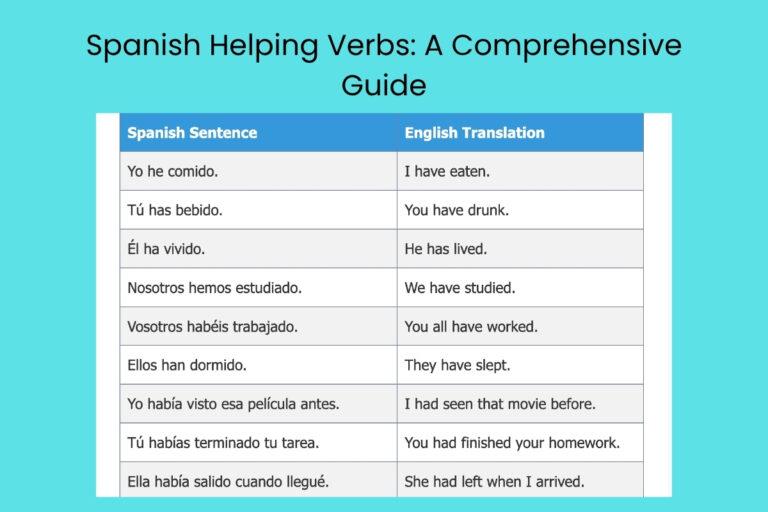
Perfect tenses are used to describe actions that have been completed at a specific point in time. Spanish has several perfect tenses, including the present perfect, past perfect (pluperfect), future perfect, and conditional perfect.
- Present Perfect (Pretérito Perfecto Compuesto): Used to describe actions that have been completed recently or that have relevance to the present. It is formed with the auxiliary verb haber (to have) in the present tense + the past participle.
- Yo he comido. (I have eaten.)
- Ella ha leído. (She has read.)
- Past Perfect (Pluperfect) (Pretérito Pluscuamperfecto): Used to describe actions that were completed before another action in the past. It is formed with the auxiliary verb haber in the imperfect tense + the past participle.
- Yo había comido antes de salir. (I had eaten before leaving.)
- Ella había leído el libro antes de ver la película. (She had read the book before seeing the movie.)
- Future Perfect (Futuro Perfecto): Used to describe actions that will be completed by a specific time in the future. It is formed with the auxiliary verb haber in the future tense + the past participle.
- Yo habré comido para las ocho. (I will have eaten by eight o’clock.)
- Ella habrá leído el libro para mañana. (She will have read the book by tomorrow.)
- Conditional Perfect (Condicional Perfecto): Used to describe actions that would have been completed under certain conditions in the past. It is formed with the auxiliary verb haber in the conditional tense + the past participle.
- Yo habría comido si hubiera tenido hambre. (I would have eaten if I had been hungry.)
- Ella habría leído el libro si hubiera tenido tiempo. (She would have read the book if she had had time.)
Understanding and using perfect tenses allows you to express more complex relationships between actions in time.
Frequently Asked Questions (FAQ)
Conclusion
Mastering Spanish action verbs is essential for effective communication in Spanish. By understanding the definition, types, usage rules, and common mistakes associated with action verbs, you can significantly improve your fluency and accuracy.
Regular practice, consistent study, and exposure to authentic Spanish language materials will further enhance your skills. Whether you are a beginner or an advanced learner, continuous effort and dedication will lead to greater proficiency in using Spanish action verbs.
Embrace the challenges and enjoy the journey of learning this beautiful and dynamic language.