Spanish Object Pronoun Placement: A Comprehensive Guide
Mastering the placement of object pronouns in Spanish is crucial for achieving fluency and avoiding common grammatical errors. Unlike English, Spanish object pronouns can appear before or after the verb, depending on the verb form and sentence structure.
This comprehensive guide will delve into the intricacies of object pronoun placement, providing clear explanations, numerous examples, and practical exercises to help you confidently navigate this essential aspect of Spanish grammar. Whether you’re a beginner or an advanced learner, this article will equip you with the knowledge and skills to use object pronouns correctly and naturally.
Understanding object pronoun placement not only enhances your grammatical accuracy but also improves your comprehension of spoken and written Spanish. Incorrect pronoun placement can lead to confusion and miscommunication, while mastering it allows you to express yourself clearly and effectively.
This guide is designed for students, teachers, and anyone seeking to improve their Spanish language proficiency. By the end of this article, you’ll have a solid understanding of the rules, exceptions, and nuances of object pronoun placement in Spanish.
Table of Contents
- Introduction
- Definition of Object Pronouns
- Structural Breakdown
- Types and Categories of Object Pronouns
- Examples of Object Pronoun Placement
- Usage Rules
- Common Mistakes
- Practice Exercises
- Advanced Topics
- FAQ
- Conclusion
Definition of Object Pronouns
Object pronouns in Spanish are words that replace nouns acting as the direct or indirect object of a verb. They indicate who or what receives the action of the verb.
Understanding their function is essential for constructing grammatically correct and natural-sounding sentences. Object pronouns prevent unnecessary repetition and make communication more concise.
Object pronouns are categorized primarily as direct object pronouns and indirect object pronouns. Direct object pronouns receive the direct action of the verb (e.g., “I see him“). Indirect object pronouns receive the indirect action of the verb, often indicating to whom or for whom something is done (e.g., “I give the book to her“). Additionally, reflexive pronouns indicate that the subject performs the action upon itself (e.g., “He washes himself“), and reciprocal pronouns express a mutual action between two or more subjects (e.g., “They love each other“).
The placement of object pronouns in Spanish differs significantly from English. In Spanish, object pronouns typically precede the conjugated verb, but they can also be attached to infinitives, gerunds, and affirmative imperative verbs.
This flexibility in placement is a key characteristic of Spanish grammar and requires careful attention to ensure accuracy.
Structural Breakdown
The structure of sentences involving object pronouns in Spanish depends on the verb form. With conjugated verbs in simple tenses, the object pronoun generally precedes the verb. For example: Yo lo veo (I see him). Here, “lo” (him) comes before “veo” (see). This is the most common structure and the foundation for understanding more complex scenarios.
When dealing with compound tenses (e.g., haber + past participle), the object pronoun can either precede the auxiliary verb (haber) or be attached to the past participle. For example: Lo he visto or He visto lo (I have seen him). While both are grammatically correct, the former is more common in modern Spanish. However, attaching the pronoun to the past participle is less frequent and may sound archaic in some contexts.
With infinitives and gerunds, the object pronoun always attaches to the end of the infinitive or gerund, forming a single word. For example: Quiero verlo (I want to see him) and Estoy viéndolo (I am seeing him). Note that when attaching pronouns to gerunds, an accent mark is added to maintain the original stress of the gerund.
In imperative sentences, the placement depends on whether the command is affirmative or negative. In affirmative commands, the object pronoun attaches to the end of the verb: Dímelo (Tell me it). In negative commands, the object pronoun precedes the verb: No me lo digas (Don’t tell me it). This distinction is crucial for giving correct commands.
Types and Categories of Object Pronouns
Direct Object Pronouns
Direct object pronouns replace the noun that directly receives the action of the verb. The direct object answers the question “Who?” or “What?” For example, in the sentence “I read the book,” the book is the direct object. The direct object pronouns in Spanish are: me, te, lo, la, nos, os, los, las.
Here’s a breakdown of the forms:
- Me: me
- Te: you (informal singular)
- Lo: him, it (masculine singular)
- La: her, it (feminine singular)
- Nos: us
- Os: you (informal plural, Spain only)
- Los: them (masculine plural)
- Las: them (feminine plural)
For example: Veo el coche. → Lo veo. (I see the car. → I see it.) Ella escribe la carta. → Ella la escribe. (She writes the letter. → She writes it.) Note how the pronoun agrees in gender and number with the noun it replaces.
Indirect Object Pronouns
Indirect object pronouns replace the noun that indirectly receives the action of the verb. The indirect object answers the question “To whom?” or “For whom?” For example, in the sentence “I give the book to Maria,” Maria is the indirect object. The indirect object pronouns in Spanish are: me, te, le, nos, os, les.
Here’s a breakdown of the forms:
- Me: to/for me
- Te: to/for you (informal singular)
- Le: to/for him, to/for her, to/for you (formal singular)
- Nos: to/for us
- Os: to/for you (informal plural, Spain only)
- Les: to/for them, to/for you (formal plural)
For example: Doy el libro a Juan. → Le doy el libro. (I give the book to Juan. → I give the book to him.) Escribo una carta a mi madre. → Le escribo una carta. (I write a letter to my mother. → I write a letter to her.) Notice that “le” can refer to both “him,” “her,” and the formal “you” (usted). Clarity is often provided by adding “a él,” “a ella,” or “a usted” for emphasis.
Reflexive Pronouns
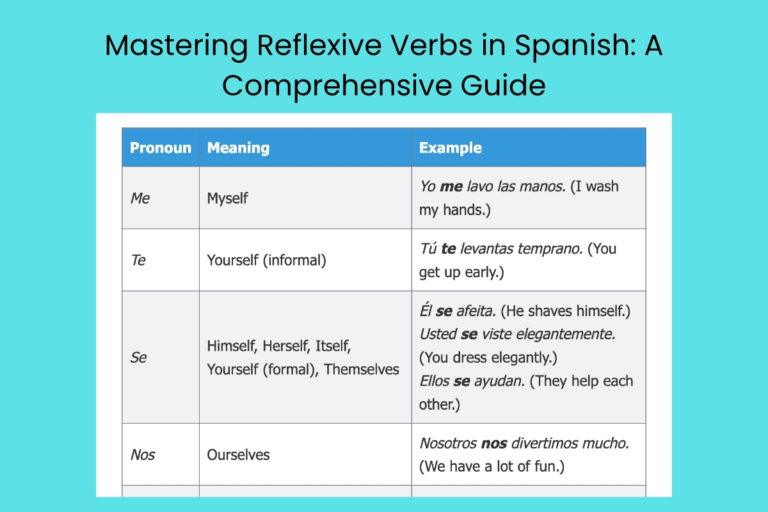
Reflexive pronouns indicate that the subject of the verb is also the object of the verb. In other words, the subject performs the action upon itself. The reflexive pronouns in Spanish are: me, te, se, nos, os, se.
Here’s a breakdown of the forms:
- Me: myself
- Te: yourself (informal singular)
- Se: himself, herself, itself, yourself (formal singular), themselves, yourselves (formal plural)
- Nos: ourselves
- Os: yourselves (informal plural, Spain only)
- Se: themselves, yourselves (formal plural)
For example: Yo me lavo. (I wash myself.) Él se viste. (He dresses himself.) Nosotros nos miramos en el espejo. (We look at ourselves in the mirror.) Reflexive pronouns are often used with verbs that describe daily routines or actions performed on oneself.
Reciprocal Pronouns
Reciprocal pronouns express a mutual action or feeling between two or more subjects. The reciprocal pronouns in Spanish are: nos, os, se. These pronouns are only used with plural subjects.
Here’s a breakdown of the forms:
- Nos: each other, one another (we)
- Os: each other, one another (you, informal plural, Spain only)
- Se: each other, one another (they, you formal plural)
For example: Nosotros nos amamos. (We love each other.) Vosotros os ayudáis. (You help each other.) Ellos se pelean. (They fight each other.) Reciprocal pronouns always imply a mutual action or relationship between multiple subjects.
Examples of Object Pronoun Placement
Affirmative Sentences
In affirmative sentences with a single conjugated verb, the object pronoun typically precedes the verb. The following table provides a variety of examples illustrating this rule.
The following table illustrates the use of object pronouns in affirmative sentences. The first column shows sentences with a noun as the object, and the second column shows the same sentences with the object replaced by an object pronoun.
This shows how the noun object is replaced by the direct or indirect object pronoun.
| Original Sentence (Noun Object) | Sentence with Object Pronoun |
|---|---|
| Yo veo a María. | Yo la veo. (I see her.) |
| Él compra el libro. | Él lo compra. (He buys it.) |
| Nosotros escribimos la carta. | Nosotros la escribimos. (We write it.) |
| Ella da el regalo a Juan. | Ella le da el regalo. (She gives the gift to Juan.) |
| Yo conozco a Pedro. | Yo lo conozco. (I know him.) |
| Él necesita el coche. | Él lo necesita. (He needs it.) |
| Nosotros queremos la casa. | Nosotros la queremos. (We want it.) |
| Ella dice la verdad a su madre. | Ella le dice la verdad. (She tells the truth to her mother.) |
| Yo escucho la música. | Yo la escucho. (I listen to the music.) |
| Él lee el periódico. | Él lo lee. (He reads the newspaper.) |
| Nosotros preparamos la cena. | Nosotros la preparamos. (We prepare the dinner.) |
| Ella muestra el cuadro a su padre. | Ella le muestra el cuadro. (She shows the painting to her father.) |
| Yo tomo el café. | Yo lo tomo. (I drink the coffee.) |
| Él vende la casa. | Él la vende. (He sells the house.) |
| Nosotros visitamos el museo. | Nosotros lo visitamos. (We visit the museum.) |
| Ella cuenta el secreto a su amiga. | Ella le cuenta el secreto. (She tells the secret to her friend.) |
| Yo recibo el paquete. | Yo lo recibo. (I receive the package.) |
| Él guarda el dinero. | Él lo guarda. (He saves the money.) |
| Nosotros compramos las entradas. | Nosotros las compramos. (We buy the tickets.) |
| Ella escribe un correo electrónico a su jefe. | Ella le escribe un correo electrónico. (She writes an email to her boss.) |
| Yo bebo el agua. | Yo la bebo. (I drink the water.) |
| Él lleva la chaqueta. | Él la lleva. (He wears the jacket.) |
| Nosotros vemos la película. | Nosotros la vemos. (We watch the movie.) |
| Ella ofrece ayuda a su vecino. | Ella le ofrece ayuda. (She offers help to her neighbor.) |
| Yo como la fruta. | Yo la como. (I eat the fruit.) |
Negative Sentences
In negative sentences, the object pronoun precedes the “no” and the verb. This structure is consistent and important to remember.
The following table provides examples.
The following table illustrates the use of object pronouns in negative sentences. The first column shows a statement with an object pronoun, and the second column shows the negative version of the same sentence.
Notice how the placement of the object pronoun changes when the sentence is made negative.
| Affirmative Sentence with Object Pronoun | Negative Sentence with Object Pronoun |
|---|---|
| Yo la veo. | Yo no la veo. (I don’t see her.) |
| Él lo compra. | Él no lo compra. (He doesn’t buy it.) |
| Nosotros la escribimos. | Nosotros no la escribimos. (We don’t write it.) |
| Ella le da el regalo. | Ella no le da el regalo. (She doesn’t give him the gift.) |
| Yo lo conozco. | Yo no lo conozco. (I don’t know him.) |
| Él lo necesita. | Él no lo necesita. (He doesn’t need it.) |
| Nosotros la queremos. | Nosotros no la queremos. (We don’t want it.) |
| Ella le dice la verdad. | Ella no le dice la verdad. (She doesn’t tell him the truth.) |
| Yo la escucho. | Yo no la escucho. (I don’t listen to it.) |
| Él lo lee. | Él no lo lee. (He doesn’t read it.) |
| Nosotros la preparamos. | Nosotros no la preparamos. (We don’t prepare it.) |
| Ella le muestra el cuadro. | Ella no le muestra el cuadro. (She doesn’t show him the painting.) |
| Yo lo tomo. | Yo no lo tomo. (I don’t drink it.) |
| Él la vende. | Él no la vende. (He doesn’t sell it.) |
| Nosotros lo visitamos. | Nosotros no lo visitamos. (We don’t visit it.) |
| Ella le cuenta el secreto. | Ella no le cuenta el secreto. (She doesn’t tell him the secret.) |
| Yo lo recibo. | Yo no lo recibo. (I don’t receive it.) |
| Él lo guarda. | Él no lo guarda. (He doesn’t save it.) |
| Nosotros las compramos. | Nosotros no las compramos. (We don’t buy them.) |
| Ella le escribe un correo electrónico. | Ella no le escribe un correo electrónico. (She doesn’t write him an email.) |
| Yo la bebo. | Yo no la bebo. (I don’t drink it.) |
| Él la lleva. | Él no la lleva. (He doesn’t wear it.) |
| Nosotros la vemos. | Nosotros no la vemos. (We don’t watch it.) |
| Ella le ofrece ayuda. | Ella no le ofrece ayuda. (She doesn’t offer him help.) |
| Yo la como. | Yo no la como. (I don’t eat it.) |
Infinitives
When an object pronoun is used with an infinitive, it is attached to the end of the infinitive, forming one word. If the infinitive is part of a verb phrase, the pronoun can also precede the conjugated verb.
The following examples illustrate these options.
The following table provides examples of object pronoun placement with infinitives. Each row presents a sentence with an infinitive phrase, showing both the option of attaching the pronoun to the infinitive and placing it before the conjugated verb.
| Sentence with Object Pronoun (Attached to Infinitive) | Sentence with Object Pronoun (Before Conjugated Verb) |
|---|---|
| Quiero verlo. (I want to see him.) | Lo quiero ver. |
| Necesito comprarlo. (I need to buy it.) | Lo necesito comprar. |
| Debo escribirla. (I should write it.) | La debo escribir. |
| Prefiero leerlo. (I prefer to read it.) | Lo prefiero leer. |
| Voy a llamarlo. (I am going to call him.) | Lo voy a llamar. |
| Tengo que hacerlo. (I have to do it.) | Lo tengo que hacer. |
| Empiezo a entenderlo. (I am starting to understand it.) | Lo empiezo a entender. |
| Pienso comprarla. (I plan to buy it.) | La pienso comprar. |
| Deseo verla. (I wish to see her.) | La deseo ver. |
| Puedo hacerlo. (I can do it.) | Lo puedo hacer. |
| Intento explicarlo. (I try to explain it.) | Lo intento explicar. |
| Quiero comprarla. (I want to buy it.) | La quiero comprar. |
| Debo leerlo. (I should read it.) | Lo debo leer. |
| Necesito escribirla. (I need to write it.) | La necesito escribir. |
| Voy a verlo. (I am going to see him.) | Lo voy a ver. |
| Tengo que leerlo. (I have to read it.) | Lo tengo que leer. |
| Empiezo a escribirla. (I am starting to write it.) | La empiezo a escribir. |
| Pienso verlo. (I plan to see him.) | Lo pienso ver. |
| Deseo comprarla. (I wish to buy it.) | La deseo comprar. |
| Puedo verla. (I can see her.) | La puedo ver. |
Gerunds
Similar to infinitives, object pronouns can be attached to the end of gerunds, forming one word. An accent mark is added to the gerund to maintain the original stress.
Alternatively, the pronoun can precede the conjugated verb in a verb phrase. The following examples illustrate these concepts.
The following table illustrates the placement of object pronouns with gerunds. The first column shows sentences with the object pronoun attached to the gerund, and the second column shows the alternative placement of the object pronoun before the conjugated verb.
| Sentence with Object Pronoun (Attached to Gerund) | Sentence with Object Pronoun (Before Conjugated Verb) |
|---|---|
| Estoy viéndolo. (I am seeing him.) | Lo estoy viendo. |
| Sigo escribiéndola. (I keep writing it.) | La sigo escribiendo. |
| Continúo leyéndolo. (I continue reading it.) | Lo continúo leyendo. |
| Ando buscándola. (I am walking around looking for it.) | La ando buscando. |
| Estoy comiéndola. (I am eating it.) | La estoy comiendo. |
| Sigo bebiéndolo. (I keep drinking it.) | Lo sigo bebiendo. |
| Continúo usándolo. (I continue using it.) | Lo continúo usando. |
| Ando llevándola. (I am walking around wearing it.) | La ando llevando. |
| Estoy haciéndolo. (I am doing it.) | Lo estoy haciendo. |
| Sigo diciéndoselo. (I keep saying it to him/her.) | Se lo sigo diciendo. |
| Continúo explicándolo. (I continue explaining it.) | Lo continúo explicando. |
| Ando reparándola. (I am walking around repairing it.) | La ando reparando. |
| Estoy vendiéndola. (I am selling it.) | La estoy vendiendo. |
| Sigo limpiándolo. (I keep cleaning it.) | Lo sigo limpiando. |
| Continúo ordenándola. (I continue ordering it.) | La continúo ordenando. |
| Ando buscándolo. (I am walking around looking for it.) | Lo ando buscando. |
| Estoy abriéndola. (I am opening it.) | La estoy abriendo. |
| Sigo cerrándolo. (I keep closing it.) | Lo sigo cerrando. |
| Continúo guardándola. (I continue saving it.) | La continúo guardando. |
| Ando escribiéndola. (I am walking around writing it.) | La ando escribiendo. |
Imperative Mood
In affirmative commands, the object pronoun is attached to the end of the verb. In negative commands, the object pronoun precedes the verb and the “no.” Understanding this distinction is vital for giving correct instructions.
The following table illustrates the placement of object pronouns in imperative sentences. The table shows both affirmative and negative commands, demonstrating how the pronoun placement differs between the two.
| Affirmative Command | Negative Command |
|---|---|
| Dímelo. (Tell me it.) | No me lo digas. (Don’t tell me it.) |
| Hazlo. (Do it.) | No lo hagas. (Don’t do it.) |
| Escríbela. (Write it.) | No la escribas. (Don’t write it.) |
| Léelo. (Read it.) | No lo leas. (Don’t read it.) |
| Cómpralo. (Buy it.) | No lo compres. (Don’t buy it.) |
| Véalo. (See it.) | No lo vea. (Don’t see it.) |
| Pruébalo. (Try it.) | No lo pruebes. (Don’t try it.) |
| Ábrelo. (Open it.) | No lo abras. (Don’t open it.) |
| Ciérralo. (Close it.) | No lo cierres. (Don’t close it.) |
| Guárdalo. (Save it.) | No lo guardes. (Don’t save it.) |
| Lávalo. (Wash it.) | No lo laves. (Don’t wash it.) |
| Cómetelo. (Eat it.) | No te lo comas. (Don’t eat it.) |
| Bébelo. (Drink it.) | No lo bebas. (Don’t drink it.) |
| Úsalo. (Use it.) | No lo uses. (Don’t use it.) |
| Llámalo. (Call him.) | No lo llames. (Don’t call him.) |
| Explícalo. (Explain it.) | No lo expliques. (Don’t explain it.) |
| Repáralo. (Repair it.) | No lo repares. (Don’t repair it.) |
| Véndelo. (Sell it.) | No lo vendas. (Don’t sell it.) |
| Límpialo. (Clean it.) | No lo limpies. (Don’t clean it.) |
| Ordénalo. (Order it.) | No lo ordenes. (Don’t order it.) |
Usage Rules
Simple Tenses
In simple tenses (present, past, future, etc.), the object pronoun generally precedes the conjugated verb. This is the most straightforward rule and serves as the foundation for more complex constructions. For instance: Yo lo veo (I see him), Ella la compró (She bought it), Nosotros lo haremos (We will do it). The pronoun’s placement before the verb is consistent across various simple tenses.
The placement of the object pronoun remains consistent regardless of the specific simple tense being used. Whether you are speaking in the present, past, future, or conditional tense, the pronoun will typically come before the conjugated verb.
This rule simplifies the process of constructing grammatically correct sentences in Spanish.
Compound Tenses
In compound tenses (e.g., present perfect, past perfect), the object pronoun can either precede the auxiliary verb (haber) or, less commonly, be attached to the past participle. For example: Lo he visto (I have seen him) or He visto lo (I have seen him). The former is more common in modern Spanish usage, while the latter may sound somewhat archaic.
When using compound tenses, it’s generally safer and more natural to place the object pronoun before the auxiliary verb. This placement is widely accepted and avoids any potential confusion or sounding outdated.
While attaching the pronoun to the past participle is grammatically correct, it is not as frequently used in contemporary Spanish.
Verb Phrases
With verb phrases consisting of a conjugated verb followed by an infinitive or gerund (e.g., querer + infinitive, estar + gerund), the object pronoun can either be attached to the infinitive/gerund or placed before the conjugated verb. For example: Quiero verlo or Lo quiero ver (I want to see him), Estoy viéndolo or Lo estoy viendo (I am seeing him). Both options are generally acceptable, although regional preferences may exist.
The flexibility in pronoun placement with verb phrases allows for stylistic variation. Some speakers may prefer attaching the pronoun to the infinitive or gerund, while others may find it more natural to place the pronoun before the conjugated verb.
Ultimately, both constructions are grammatically correct, and the choice often comes down to personal preference or regional dialect.
Exceptions
There are some exceptions to the general rules of object pronoun placement. One notable exception involves affirmative commands, where the object pronoun is always attached to the end of the verb. For example: Dímelo (Tell me it). This rule is consistent and must be followed to avoid grammatical errors.
Another exception arises when using certain impersonal constructions, particularly those involving the impersonal “se.” In these cases, the pronoun placement may deviate from the standard rules. These constructions are more complex and require careful attention to the specific context and grammatical structure.
Common Mistakes
One of the most common mistakes is placing the object pronoun after the conjugated verb in simple tenses.
- Incorrect: Yo veo lo.
- Correct: Yo lo veo. (I see it.)
Another frequent error is failing to attach the object pronoun correctly to infinitives or gerunds.
- Incorrect: Quiero ver lo.
- Correct: Quiero verlo. (I want to see it.)
Misunderstanding the placement in negative commands is also a common pitfall.
- Incorrect: No digas lo.
- Correct: No lo digas. (Don’t say it.)
Using the incorrect form of the object pronoun is another common error. This can involve using the wrong gender or number, or confusing direct and indirect object pronouns.
- Incorrect: Le veo a María. (Using ‘le’ when ‘la’ is needed for a direct object)
- Correct: La veo a María. (I see Maria.)
Confusing reflexive and reciprocal pronouns is another area where learners often make mistakes.
- Incorrect: Ellos se aman a ellos mismos. (Using ‘a ellos mismos’ is redundant when ‘se’ already indicates a reflexive action. It is possible but unnatural)
- Correct: Ellos se aman. (They love each other.)
Practice Exercises
<
Exercise 1: Identifying Object Pronouns
Identify the object pronouns in the following sentences and indicate whether they are direct, indirect, reflexive, or reciprocal.
- Yo te veo en el parque.
- Ella me da el libro.
- Nosotros nos lavamos las manos.
- Ellos se ayudan mutuamente.
- Él lo compró ayer.
- Yo le escribo una carta.
- Tú te vistes rápidamente.
- Nosotros nos queremos mucho.
- Ella la conoce bien.
- Él me lo dijo ayer.
Answer Key:
- Te (direct)
- Me (indirect)
- Nos (reflexive)
- Se (reciprocal)
- Lo (direct)
- Le (indirect)
- Te (reflexive)
- Nos (reciprocal)
- La (direct)
- Me (indirect), lo (direct)
Placing Object Pronouns Correctly
Rewrite the following sentences, placing the object pronouns in the correct position.
- Yo quiero ver lo.
- Ella no tiene lo.
- Él está comiendo la.
- Nosotros vamos a escribir la.
- Tú debes decir me la verdad.
- Yo no puedo hacer lo.
- Ella está leyendo lo.
- Nosotros queremos comprar la.
- Él va a vender la casa.
- Yo necesito hacer lo ahora.
Answer Key:
- Yo lo quiero ver / Yo quiero verlo.
- Ella no lo tiene.
- Él la está comiendo / Él está comiéndola.
- Nosotros la vamos a escribir / Nosotros vamos a escribirla.
- Tú me debes decir la verdad.
- Yo no lo puedo hacer / Yo no puedo hacerlo.
- Ella lo está leyendo / Ella está leyéndolo.
- Nosotros la queremos comprar / Nosotros queremos comprarla.
- Él la va a vender.
- Yo lo necesito hacer ahora.
Combining Direct and Indirect Object Pronouns
Combine the direct and indirect object pronouns in the following sentences, placing them correctly before the verb.
- Yo doy el libro a Juan. (I give the book to Juan.)
- Ella escribe la carta a mí. (She writes the letter to me.)
- Nosotros decimos la verdad a ellos. (We tell the truth to them.)
- Él compra los dulces para ella. (He buys the candies for her.)
- Yo presto el coche a ti. (I lend the car to you.)
- Ella muestra las fotos a nosotros. (She shows the photos to us.)
- Nosotros vendemos la casa a ellos. (We sell the house to them.)
- Él ofrece ayuda a mí. (He offers help to me.)
- Yo cuento el secreto a ti. (I tell the secret to you.)
- Ella lee el cuento a él. (She reads the story to him.)
Answer Key:
- Yo se lo doy.
- Ella me la escribe.
- Nosotros se la decimos.
- Él se los compra.
- Yo te lo presto.
- Ella nos las muestra.
- Nosotros se la vendemos.
- Él me la ofrece.
- Yo te lo cuento.
- Ella se lo lee.
Advanced Topics
Leísmo, Laísmo, and Loísmo
Leísmo, laísmo, and loísmo are phenomena in Spanish dialects related to the misuse of the object pronouns le, la, and lo. These usages are often considered incorrect in standard Spanish but are common in certain regions.
- Leísmo: Using le as a direct object pronoun when referring to a male person. While accepted by the Royal Spanish Academy (RAE) under certain conditions (specifically, when referring to a male person and when the speaker is from a leísta region), it is generally discouraged in formal writing and education.
- Example: Le vi ayer. (Instead of Lo vi ayer. – I saw him yesterday.)
- Laísmo: Using la as an indirect object pronoun, typically when referring to a female person. This is generally considered incorrect.
- Example: La di el libro. (Instead of Le di el libro. – I gave her the book.)
- Loísmo: Using lo as an indirect object pronoun. This is also generally considered incorrect.
- Example: Lo di el libro a Juan. (Instead of Le di el libro a Juan. – I gave the book to Juan.)
Understanding these phenomena is important for recognizing regional variations in Spanish and avoiding non-standard usages in formal contexts.
The Impersonal ‘Se’
The impersonal “se” is a construction in Spanish used to express impersonal or indefinite actions, where the subject is not specified or is irrelevant. In these constructions, “se” is not a reflexive pronoun but rather an indicator of impersonality.
The verb is typically conjugated in the third person singular.
Examples:
- Se habla español aquí. (Spanish is spoken here.)
- Se vive bien en España. (One lives well in Spain.)
- Se dice que va a llover. (It is said that it is going to rain.)
The impersonal “se” is often used to express general truths, rules, or customs. It’s a valuable tool for expressing ideas without specifying who performs the action.
FAQ
Q: Can I always attach object pronouns to the end of infinitives and gerunds?
A: Yes, you can always attach object pronouns to the end of infinitives and gerunds, but you also have the option of placing them before the conjugated verb in a verb phrase. Both options are generally correct, but regional preferences may vary.
Q: What is the correct placement of object pronouns in negative sentences?
A: In negative sentences, the object pronoun precedes the “no” and the verb: No lo veo (I don’t see it).
Q: How do I handle sentences with both direct and indirect object pronouns?
A: When using both direct and indirect object pronouns, the indirect object pronoun comes before the direct object pronoun. If both pronouns begin with “l” (le, les, lo, la, los, las), the indirect object pronoun changes to “se”: Yo le doy el libro a Juan → Yo se lo doy (I give the book to Juan → I give it to him).
Q: Is it always wrong to use ‘le’ as a direct object pronoun?
A: While generally discouraged in formal Spanish, the Royal Spanish Academy (RAE) accepts leísmo (using ‘le’ as a direct object pronoun for male persons) under certain conditions, especially in regions where it is common. However, it’s best to avoid it in formal writing and education.
Q: How do I know when to use the impersonal “se”?
A: Use the impersonal “se” when you want to express an action without specifying who performs it, or when the subject is indefinite or irrelevant. It is often used to express general truths, rules, or customs.
Conclusion
Mastering the placement of object pronouns in Spanish is essential for fluency and accuracy. By understanding the rules, exceptions, and nuances discussed in this guide, you can confidently construct grammatically correct and natural-sounding sentences.
Remember to pay attention to the verb form, sentence structure, and regional variations to ensure proper pronoun placement. With practice and attention to detail, you’ll be able to use object pronouns effectively and enhance your overall Spanish language proficiency.