Spanish Grammar: A Step-by-Step Learning Guide
Spanish grammar, while initially daunting, becomes manageable with a structured approach. Understanding the fundamentals of Spanish grammar is essential for effective communication, whether you’re planning a trip to Spain, connecting with Spanish-speaking friends, or pursuing professional opportunities.
This guide provides a step-by-step breakdown of the key elements of Spanish grammar, offering clear explanations, practical examples, and helpful exercises. By mastering these concepts, learners can build a solid foundation for fluency and confidence in their Spanish language skills.
This article aims to serve as a comprehensive resource for learners of all levels, from beginners to advanced students. It covers essential topics such as nouns, adjectives, verbs, tenses, and sentence structure, breaking down complex rules into understandable segments.
Whether you’re a self-taught learner or enrolled in a formal Spanish course, this step-by-step guide will help you navigate the intricacies of Spanish grammar and achieve your language learning goals.
Table of Contents
- Introduction
- Definition of Spanish Grammar
- Structural Breakdown of Spanish Grammar
- Nouns and Articles
- Adjectives
- Verbs
- Verb Tenses
- Pronouns
- Prepositions
- Adverbs
- Sentence Structure
- Usage Rules
- Common Mistakes
- Practice Exercises
- Advanced Topics
- FAQ
- Conclusion
Definition of Spanish Grammar
Spanish grammar encompasses the set of structural rules governing the composition of clauses, phrases, and words in the Spanish language. These rules dictate how words are combined to form meaningful sentences.
Understanding Spanish grammar is crucial for both comprehension and production of the language, enabling learners to accurately interpret and construct sentences.
Like all grammars, Spanish grammar includes morphology (the study of word formation) and syntax (the study of sentence structure). Morphology deals with how words are formed from smaller units called morphemes, while syntax governs the arrangement of words in a sentence to convey meaning.
Mastering these elements is essential for achieving fluency and accuracy in Spanish.
Structural Breakdown of Spanish Grammar
The basic structure of Spanish grammar includes several key components: nouns, articles, adjectives, verbs, pronouns, prepositions, and adverbs. Each of these parts of speech plays a specific role in constructing sentences.
Understanding how these components interact is essential for mastering Spanish grammar.
Spanish syntax often follows a Subject-Verb-Object (SVO) word order, similar to English. However, Spanish is more flexible than English, and variations in word order can occur for emphasis or stylistic reasons.
Additionally, Spanish grammar includes features such as verb conjugations, noun-adjective agreement, and the use of subjunctive moods, which require careful attention.
Nouns and Articles
Nouns (sustantivos) in Spanish represent people, places, things, or ideas. They are always either masculine or feminine, and they can be singular or plural. Articles (artículos) are words that precede nouns to indicate whether the noun is specific or general.
Gender and Number
In Spanish, every noun has a gender: masculine (masculino) or feminine (femenino). The gender of a noun is often, but not always, indicated by its ending. Nouns ending in -o are usually masculine, while those ending in -a are usually feminine. However, there are exceptions, such as la mano (the hand), which is feminine despite ending in -o.
Nouns also have a number: singular (singular) or plural (plural). To make a noun plural, add -s to nouns ending in a vowel, and -es to nouns ending in a consonant. For example, libro (book) becomes libros (books), and árbol (tree) becomes árboles (trees).
Definite and Indefinite Articles
Definite articles (artículos definidos) are used to refer to specific nouns. The definite articles in Spanish are el (masculine singular), la (feminine singular), los (masculine plural), and las (feminine plural). Indefinite articles (artículos indefinidos) are used to refer to general or unspecified nouns. The indefinite articles in Spanish are un (masculine singular), una (feminine singular), unos (masculine plural), and unas (feminine plural).
The following table illustrates the usage of definite and indefinite articles in Spanish:
| Article Type | Masculine Singular | Feminine Singular | Masculine Plural | Feminine Plural |
|---|---|---|---|---|
| Definite | el | la | los | las |
| Indefinite | un | una | unos | unas |
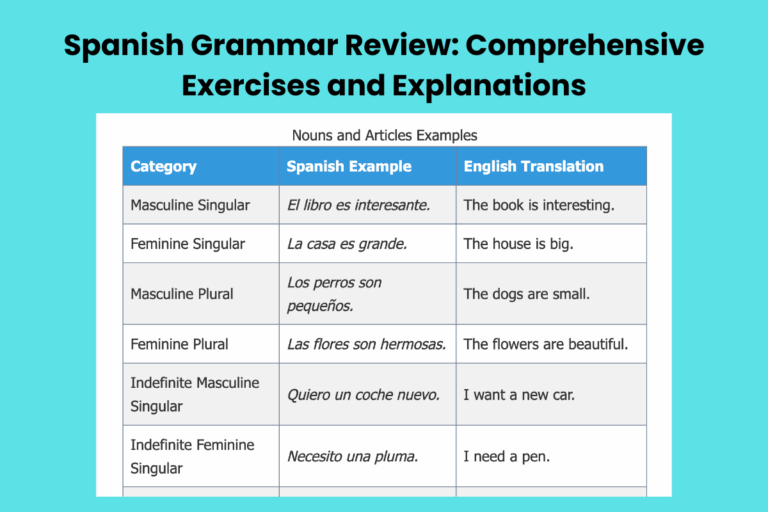
Here are some examples showing the use of nouns and articles:
| Spanish | English |
|---|---|
| El libro es interesante. | The book is interesting. |
| La casa es grande. | The house is big. |
| Los perros son amigables. | The dogs are friendly. |
| Las flores son hermosas. | The flowers are beautiful. |
| Un hombre camina por la calle. | A man walks down the street. |
| Una mujer lee un libro. | A woman reads a book. |
| Unos niños juegan en el parque. | Some children play in the park. |
| Unas chicas escuchan música. | Some girls listen to music. |
| El sol brilla en el cielo. | The sun shines in the sky. |
| La luna está llena esta noche. | The moon is full tonight. |
| Los coches son rápidos. | The cars are fast. |
| Las montañas son altas. | The mountains are tall. |
| Un pájaro canta en el árbol. | A bird sings in the tree. |
| Una estrella brilla en la noche. | A star shines at night. |
| Unos amigos se reúnen en el café. | Some friends meet at the cafe. |
| Unas amigas van de compras. | Some friends go shopping. |
| El río fluye hacia el mar. | The river flows to the sea. |
| La ciudad está llena de vida. | The city is full of life. |
| Los estudiantes estudian para el examen. | The students study for the exam. |
| Las profesoras enseñan con pasión. | The teachers teach with passion. |
Adjectives
Adjectives (adjetivos) in Spanish describe nouns. They provide more information about the qualities or characteristics of the nouns they modify. Like nouns, adjectives in Spanish must agree in gender and number with the nouns they describe.
Agreement
Adjective agreement is a fundamental aspect of Spanish grammar. An adjective must match the noun it modifies in both gender and number.
If the noun is masculine singular, the adjective must also be masculine singular. The same applies to feminine singular, masculine plural, and feminine plural forms.
For example:
- El libro interesante (The interesting book) – Masculine singular
- La casa grande (The big house) – Feminine singular
- Los libros interesantes (The interesting books) – Masculine plural
- Las casas grandes (The big houses) – Feminine plural
Position
In Spanish, adjectives usually follow the noun they modify, unlike in English where adjectives typically precede the noun. However, certain adjectives, such as those indicating quantity or opinion, may precede the noun.
This can subtly change the meaning or emphasis of the sentence.
Examples:
- El coche rojo (The red car) – Normal position
- Una buena persona (A good person) – Adjective before the noun
Comparative and Superlative
Spanish adjectives can also be used to make comparisons. Comparative adjectives compare two things, while superlative adjectives indicate the highest degree of a quality.
To form the comparative, use más (more) or menos (less) before the adjective, followed by que (than). To form the superlative, use el/la/los/las más/menos before the adjective.
Examples:
- Este libro es más interesante que ese. (This book is more interesting than that one.)
- Ella es la más inteligente de la clase. (She is the most intelligent in the class.)
Here are some examples showcasing the use of adjectives in Spanish:
| Spanish | English |
|---|---|
| La casa blanca. | The white house. |
| El coche rápido. | The fast car. |
| Las flores hermosas. | The beautiful flowers. |
| Los perros grandes. | The big dogs. |
| Un hombre alto. | A tall man. |
| Una mujer inteligente. | An intelligent woman. |
| Unos niños felices. | Some happy children. |
| Unas chicas jóvenes. | Some young girls. |
| El sol brillante. | The bright sun. |
| La luna llena. | The full moon. |
| Los coches nuevos. | The new cars. |
| Las montañas altas. | The tall mountains. |
| Un pájaro pequeño. | A small bird. |
| Una estrella brillante. | A shining star. |
| Unos amigos divertidos. | Some fun friends. |
| Unas amigas simpáticas. | Some nice friends. |
| El río caudaloso. | The wide river. |
| La ciudad moderna. | The modern city. |
| Los estudiantes aplicados. | The diligent students. |
| Las profesoras dedicadas. | The dedicated teachers. |
| El libro interesante. | The interesting book. |
| La película emocionante. | The exciting movie. |
| Los días soleados. | The sunny days. |
| Las noches oscuras. | The dark nights. |
| Un problema difícil. | A difficult problem. |
| Una solución fácil. | An easy solution. |
Verbs
Verbs (verbos) are words that express actions, states, or occurrences. In Spanish, verbs are conjugated to indicate tense, mood, person, and number. Verb conjugation is a critical aspect of Spanish grammar, and mastering it is essential for forming grammatically correct sentences.
Conjugation
Spanish verbs are typically grouped into three conjugations based on their infinitive endings: -ar, -er, and -ir. Each conjugation has its own set of endings that change depending on the tense, mood, person, and number. Regular verbs follow predictable conjugation patterns, while irregular verbs have unique forms that must be memorized.
For example, the verb hablar (to speak) is an -ar verb. Its present tense conjugation is:
| Pronoun | Conjugation | English |
|---|---|---|
| Yo | hablo | I speak |
| Tú | hablas | You speak |
| Él/Ella/Usted | habla | He/She/You speak |
| Nosotros/Nosotras | hablamos | We speak |
| Vosotros/Vosotras | habláis | You (plural) speak |
| Ellos/Ellas/Ustedes | hablan | They/You (plural) speak |
Similarly, the verb comer (to eat) is an -er verb, and vivir (to live) is an -ir verb. Their conjugations follow different patterns, but the same principles apply.
Verb Tenses
Spanish has a rich system of verb tenses that allow speakers to express actions in various time frames. Mastering these tenses is essential for conveying precise meanings and nuances in Spanish.
Present Tense (Presente)
The present tense is used to describe actions happening now, habitual actions, or general truths. It is formed by conjugating the verb according to its infinitive ending (-ar, -er, or -ir) and the subject pronoun.
Examples:
- Yo hablo español. (I speak Spanish.)
- Ella come fruta todos los días. (She eats fruit every day.)
- Nosotros vivimos en Madrid. (We live in Madrid.)
Preterite Tense (Pretérito Indefinido)
The preterite tense is used to describe completed actions in the past that occurred at a specific time. It is often used for events that have a clear beginning and end.
Examples:
- Yo hablé con mi madre ayer. (I spoke with my mother yesterday.)
- Ella comió pizza anoche. (She ate pizza last night.)
- Nosotros vivimos en Barcelona el año pasado. (We lived in Barcelona last year.)
Imperfect Tense (Pretérito Imperfecto)
The imperfect tense is used to describe ongoing or habitual actions in the past, as well as to set the scene or provide background information. It is often used for actions that do not have a clear beginning or end.
Examples:
- Yo hablaba español cuando era niño. (I used to speak Spanish when I was a child.)
- Ella comía fruta todos los días cuando vivía aquí. (She used to eat fruit every day when she lived here.)
- Nosotros vivíamos en una casa grande. (We used to live in a big house.)
Future Tense (Futuro Simple)
The future tense is used to describe actions that will happen in the future. It is formed by adding specific endings to the infinitive of the verb.
Examples:
- Yo hablaré con mi jefe mañana. (I will speak with my boss tomorrow.)
- Ella comerá en un restaurante elegante. (She will eat at an elegant restaurant.)
- Nosotros viviremos en otro país algún día. (We will live in another country someday.)
Conditional Tense (Condicional Simple)
The conditional tense is used to describe actions that would happen under certain conditions, or to express polite requests or suggestions. It is formed by adding specific endings to the infinitive of the verb.
Examples:
- Yo hablaría español si tuviera más tiempo. (I would speak Spanish if I had more time.)
- Ella comería pescado si no fuera alérgica. (She would eat fish if she weren’t allergic.)
- Nosotros viviríamos en la playa si pudiéramos. (We would live on the beach if we could.)
The table below provides additional examples of verb conjugations in various tenses:
| Pronoun | Present (Hablar) | Preterite (Hablar) | Imperfect (Hablar) | Future (Hablar) | Conditional (Hablar) |
|---|---|---|---|---|---|
| Yo | hablo | hablé | hablaba | hablaré | hablaría |
| Tú | hablas | hablaste | hablabas | hablarás | hablarías |
| Él/Ella/Usted | habla | habló | hablaba | hablará | hablaría |
| Nosotros/Nosotras | hablamos | hablamos | hablábamos | hablaremos | hablaríamos |
| Vosotros/Vosotras | habláis | hablasteis | hablabais | hablaréis | hablaríais |
| Ellos/Ellas/Ustedes | hablan | hablaron | hablaban | hablarán | hablarían |
Pronouns
Pronouns (pronombres) are words that replace nouns in a sentence. They are used to avoid repetition and make sentences more concise. Spanish has several types of pronouns, including subject pronouns, object pronouns, and reflexive pronouns.
Subject Pronouns
Subject pronouns indicate who is performing the action of the verb. The Spanish subject pronouns are:
- Yo (I)
- Tú (You, informal singular)
- Él (He)
- Ella (She)
- Usted (You, formal singular)
- Nosotros/Nosotras (We)
- Vosotros/Vosotras (You, informal plural)
- Ellos/Ellas (They)
- Ustedes (You, formal plural)
Examples:
- Yo estudio español. (I study Spanish.)
- Ella trabaja en una oficina. (She works in an office.)
- Nosotros vamos al cine. (We are going to the cinema.)
Object Pronouns
Object pronouns replace nouns that are the direct or indirect object of a verb. Direct object pronouns receive the action of the verb, while indirect object pronouns indicate to whom or for whom the action is done.
The direct object pronouns are: me, te, lo/la, nos, os, los/las.
The indirect object pronouns are: me, te, le, nos, os, les.
Examples:
- Me ves. (You see me.)
- Te doy un regalo. (I give you a gift.)
- Lo compro. (I buy it.)
- Le digo la verdad. (I tell him/her the truth.)
Reflexive Pronouns
Reflexive pronouns are used when the subject and object of a verb are the same. They indicate that the subject is performing the action on itself.
The reflexive pronouns are: me, te, se, nos, os, se.
Examples:
- Yo me lavo. (I wash myself.)
- Ella se viste. (She gets dressed.)
- Nosotros nos levantamos temprano. (We get up early.)
Prepositions
Prepositions (preposiciones) are words that connect nouns, pronouns, or phrases to other words in a sentence. They indicate relationships of time, place, direction, or manner.
Common Spanish prepositions include: a (to), en (in, on, at), de (of, from), para (for, to), por (by, for), con (with), sin (without), sobre (on, about), entre (between, among).
Examples:
- Voy a la tienda. (I am going to the store.)
- El libro está en la mesa. (The book is on the table.)
- Soy de España. (I am from Spain.)
- Este regalo es para ti. (This gift is for you.)
Adverbs
Adverbs (adverbios) are words that modify verbs, adjectives, or other adverbs. They provide information about how, when, where, or to what extent an action is performed.
Common Spanish adverbs include: bien (well), mal (badly), rápidamente (quickly), lentamente (slowly), siempre (always), nunca (never), aquí (here), allí (there), muy (very), poco (little).
Examples:
- Ella canta bien. (She sings well.)
- Él corre rápidamente. (He runs quickly.)
- Siempre estudio por la noche. (I always study at night.)
- Está muy cansado. (He is very tired.)
Sentence Structure
The basic sentence structure in Spanish typically follows the Subject-Verb-Object (SVO) order, similar to English. However, Spanish is more flexible, and the order can be varied for emphasis or stylistic reasons.
For example:
- Yo como manzanas. (I eat apples.) – SVO
- Manzanas como yo. (Apples I eat.) – OVS (emphasis on apples)
Spanish sentences often include additional elements such as adverbs, prepositional phrases, and clauses, which can add complexity and detail to the meaning.
Usage Rules
Spanish grammar has specific rules that govern the correct usage of various grammatical elements. These rules include noun-adjective agreement, verb conjugation, pronoun placement, and preposition usage.
Understanding and following these rules is essential for accurate and effective communication in Spanish.
One important rule is noun-adjective agreement, where adjectives must match the gender and number of the nouns they modify. Another crucial rule is verb conjugation, where verbs must be conjugated correctly based on the tense, mood, person, and number.
There are also specific rules for the placement of pronouns, especially object pronouns, which typically precede the verb in Spanish. Prepositions also have specific usage rules, and the correct preposition must be chosen based on the context and the relationship between the words it connects.
Common Mistakes
Learners of Spanish often make common mistakes related to grammar, particularly in areas such as noun-adjective agreement, verb conjugation, and pronoun usage. Recognizing and avoiding these mistakes is crucial for improving accuracy and fluency.
One common mistake is incorrect noun-adjective agreement, such as using a masculine adjective with a feminine noun or vice versa. Another frequent error is incorrect verb conjugation, particularly with irregular verbs or less common tenses.
Incorrect pronoun usage, such as confusing direct and indirect object pronouns or using the wrong reflexive pronoun, is also a common mistake. Additionally, learners may misuse prepositions, choosing the wrong preposition for a particular context.
Here are some examples of common mistakes and their corrections:
| Incorrect | Correct | Explanation |
|---|---|---|
| El casa blanca. | La casa blanca. | Noun-adjective agreement (casa is feminine) |
| Yo sabo la respuesta. | Yo sé la respuesta. | Correct verb conjugation (saber – to know) |
| Le veo a María. | Veo a María. | Unnecessary indirect object pronoun |
| Voy en la casa. | Voy a la casa. | Correct preposition usage (a – to) |
| Yo tengo diez años. | Yo tengo diez año. | Incorrect noun-adjective agreement |
| Ella es muy gusto. | A ella le gusta mucho. | Incorrect use of the verb gustar. |
| Hice un bueno trabajo. | Hice un buen trabajo. | Adjective placement and form |
| Yo quiero que tu vienes. | Yo quiero que vengas. | Subjunctive usage |
| El problema es más grande que yo pensaba. | El problema es mayor de lo que yo pensaba. | Comparative form |
| Lo siento, estoy tarde. | Lo siento, llego tarde. | Correct use of “llegar” |
| Estoy de acuerdo contigo en que… | Estoy de acuerdo con usted en que… | Formal vs. informal – use “contigo” with “tú” |
| Ella es casada con Juan hace cinco años. | Ella está casada con Juan desde hace cinco años. | Correct preposition and tense |
| El libro es muy interesante para mí. | El libro me interesa mucho. | Using “interesar” correctly |
| Él tiene mucho calor. | Él tiene mucho calor. | Correct idiom usage |
| Yo voy a hacer una pregunta a usted. | Voy a hacerle una pregunta. | Object pronoun placement |
| Ellos son muy simpáticos por mí. | Ellos son muy simpáticos conmigo. | Correct preposition |
| Es necesario que tu estudias. | Es necesario que estudies. | Subjunctive mood |
| Yo pienso que es bueno. | Creo que es bueno. | More common expression |
| Estoy esperando por ti. | Te estoy esperando. | Correct preposition |
Practice Exercises
To reinforce your understanding of Spanish grammar, complete the following practice exercises. Each exercise focuses on a specific grammar topic and includes a set of questions with answers provided below.
Exercise 1: Noun-Adjective Agreement
Fill in the blank with the correct form of the adjective.
| Question | Answer |
|---|---|
| El libro es ____________ (interesante). | interesante |
| La casa es ____________ (grande). | grande |
| Los perros son ____________ (amigable). | amigables |
| Las flores son ____________ (hermoso). | hermosas |
| El coche es ____________ (nuevo). | nuevo |
| La silla es ____________ (cómodo). | cómoda |
| Los árboles son ____________ (alto). | altos |
| Las playas son ____________ (bonito). | bonitas |
| El día es ____________ (soleado). | soleado |
| La
mesa es ____________ (redondo). |
redonda |
Exercise 2: Verb Conjugation (Present Tense)
Conjugate the verb in parentheses in the present tense.
| Question | Answer |
|---|---|
| Yo ____________ (hablar) español. | hablo |
| Ella ____________ (comer) fruta. | come |
| Nosotros ____________ (vivir) en Madrid. | vivimos |
| Tú ____________ (estudiar) mucho. | estudias |
| Él ____________ (trabajar) en una oficina. | trabaja |
| Ustedes ____________ (escribir) cartas. | escriben |
| Ellos ____________ (leer) libros. | leen |
| Vosotros ____________ (aprender) español. | aprendéis |
| Yo ____________ (comprender) la lección. | comprendo |
| Ella ____________ (abrir) la puerta. | abre |
Exercise 3: Pronoun Usage
Choose the correct pronoun to complete the sentence.
| Question | Answer |
|---|---|
| ____________ veo en el espejo. (Yo/Me) | Me |
| ____________ doy un regalo. (Te/Tú) | Te |
| ____________ compro el libro. (Lo/Él) | Lo |
| ____________ decimos la verdad. (Les/Ellos) | Les |
| ____________ lavo las manos. (Me/Yo) | Me |
| ____________ viste elegantemente. (Ella/Se) | Se |
| ____________ levantamos temprano. (Nosotros/Nos) | Nos |
| ____________ dan un consejo. (Os/Vosotros) | Os |
| ____________ llamo por teléfono. (Te/Tú) | Te |
| ____________ explico la situación. (Le/Él) | Le |
Advanced Topics
Once you have a solid understanding of the fundamentals of Spanish grammar, you can explore more advanced topics to further enhance your language skills. These topics include the subjunctive mood, complex sentence structures, idiomatic expressions, and regional variations.
The subjunctive mood is used to express doubt, uncertainty, wishes, and emotions. It is a complex aspect of Spanish grammar that requires careful study and practice.
Complex sentence structures involve the use of multiple clauses and conjunctions to express more nuanced and detailed ideas.
Idiomatic expressions are phrases or expressions that have a meaning different from the literal meaning of the individual words. Mastering idiomatic expressions can greatly improve your fluency and understanding of Spanish.
Regional variations in grammar and vocabulary also exist, and being aware of these variations can help you communicate more effectively with speakers from different regions.
FAQ
Q: How long does it take to master Spanish grammar?
A: The time it takes to master Spanish grammar varies depending on individual learning styles, dedication, and prior language learning experience. However, with consistent study and practice, you can achieve a solid understanding of the fundamentals in a few months.
Q: What is the best way to learn Spanish grammar?
A: The best way to learn Spanish grammar is through a combination of structured study, practical exercises, and real-world practice. Use textbooks, online resources, and language learning apps to learn the rules, and then practice applying them through speaking, writing, and reading.
Q: Are there any shortcuts to learning Spanish grammar?
A: While there are no shortcuts to mastering Spanish grammar, you can accelerate your learning by focusing on the most essential concepts first and then gradually building on that foundation. Prioritize noun-adjective agreement, verb conjugation, and pronoun usage, and then move on to more advanced topics as you progress.
Q: How can I improve my Spanish grammar skills?
A: You can improve your Spanish grammar skills by practicing regularly, seeking feedback from native speakers or language teachers, and immersing yourself in the language through reading, listening, and speaking. Pay attention to your mistakes and learn from them, and don’t be afraid to ask questions.
Conclusion
Mastering Spanish grammar is essential for effective communication and fluency in the Spanish language. By understanding the fundamentals of nouns, adjectives, verbs, pronouns, prepositions, and adverbs, and by practicing regularly, you can build a solid foundation for your language learning journey.
Remember to focus on noun-adjective agreement, verb conjugation, and pronoun usage, and to seek opportunities to practice your skills in real-world situations. With dedication and persistence, you can achieve your goals and communicate confidently in Spanish.